The Liberal party of Canada is choosing a new leader this weekend. In the past week, the buzz has been about a motion before the House of Commons calling the Quebecois a "nation" within Canada. As has happened in the past, the argument about Quebec's place in or deal with Canada has devolved into a debate about linguistics (what is a nation? what's the difference between a Quebecois and a Quebecker, other than the french-english translation?).
Chantal Hebert, columnist for the Toronto Star, makes a point about the issue that should be dominating this weekend's leadership vote:
The environment, not Quebec's arrangement with the rest of Canada, has dominated the public discourse this fall; an overwhelming number of voters currently disapprove of [PM] Harper's performance on the issue. It is the calling card of the Green party and it stands to be the sleeper issue in the next election.
As of today, the Liberals would be well-advised to spend as little time as possible enshrining their status as an endangered species in Quebec and as much time as possible supplying their party with oxygen on the environment.
After all, it is not as if the Liberal record on the environment was that much more commendable than the party's standing in Quebec.
Thursday, November 30, 2006
Role of environment in Canadian leadership battle


Wednesday, November 29, 2006
Upcoming AMS statement on climate change
The American Meteorological Society, the professional organization for many atmosphere and ocean scientists, is preparing a statement about climate change that presumably will be released at the annual meeting in January (?).
The current draft is a reasoned summary of the scientific evidence, and how that evidence should be interpreted and used. Since the organization is US-based, the climate change impacts of the paper tend to focus on the US (Alaskan permafrost, western water concerns). I'd like to see more mention of the sensitivity of the planet's ecosystems to climate variability and change, and examples of ecological impacts of past and projected future climate change (species migration, coral reefs, etc.). But that is less the mandate of AMS than other scientific organizations.
For a very direct summary of the evidence for human influence on the climate, I suggest reading the amicus brief (jump down to page 16 of the pdf) filed by 15 top scientists for the Supreme Court case. Thanks to Realclimate for the link.
Climate change before the US Supreme Court
Following on yesterday’s post about the possibility for action on climate change in the US:
The US Supreme Court began hearing arguments today in a case about whether the EPA is required to regulate CO2 emissions under the Clean Air Act (see yesterday’s strong NY Times editorial). The suit was filed by a bunch of states and environmental organizations after the Bush Administration chose not to enforce any CO2 regulations.
From my understanding of the case, the court could effectively decide one of four ways.
i) The EPA must regulate CO2 under the Clean Air Act (because of the potential deleterious impacts of climate change)
ii) The EPA has the option to regulate CO2 under the Clean Air Act
iii) CO2 does not fall under the Clean Air Act but could be regulated otherwise
iv) The EPA does not have jurisdiction to regulate CO2, as there is not sufficient evidence to support the need for CO2 emissions controls.
The unlikely Door #1 would radically alter the status of emissions control in the US. It’s most likely the court decision, expected in the spring, will be along the lines of Door #3. Though that would technically be a losing verdict, it would strongly advance the argument for emissions policy.
There’s one thing that makes this case risky: the chance, albeit small, that the court meanders close to Door #4. This would not only make federal emissions controls unlikely, it could be used to argue against state policies or international agreements.
Tuesday, November 28, 2006
Calls for climate change legislation in the US
 The organization Environment New Jersey is calling for Governor John Corzine to pledge to reduce the NJ's greenhouse gas emissions by 70% by the year 2050. It is also encouraging NJ legislators to support the federal Safe Climate Act (supported by Rep. Waxman of California) that would cut emissions to 1990 levels by 2020 and 80% below 1990 levels by 2050. If you're interested in joining the campaign, check the organization's website.
Tuesday, November 21, 2006
"Carbon tax" in the US?
Neglected in the initial media excitement over the Democratic sweep in the U.S mid-term elections was a local ballot initiative in the city of Boulder, Colorado.
Voters there approved what is essentially a carbon tax. The new tax is based on the home energy use (ie. $per kWh) and the revenues will go to the city's Environmental Affairs Office. The city council is hoping it will help Boulder reduce its GHG emissions to 7% below 1990 levels by the year 2012, a goal based on the Kyoto Protocol.
Similar initiatives exist in Portland, Oregon and Austin, Texas. Small steps in a few liberal communities, sure. But you have to start somewhere.
Sunday, November 19, 2006
The final word from Nairobi
Snippets from the UN FCCC final report:
"At the meeting, activities for the next few years under the 'Nairobi Work programme on Impacts, Vulnerability and Adaptation' were agreed. These activities will help enhance decision-making on adaptation action and improved assessment of vulnerability and adaptation to climate change.
Another important outcome is the agreement on the management of the Adaptation Fund under the Kyoto Protocol. The Adaptation Fund draws on proceeds generated by the clean development mechanism (CDM) and is designed to support concrete adaptation activities in developing countries.
The CDM permits industrialized countries, which have emission targets under the Kyoto Protocol, to invest in sustainable development projects in developing countries that reduce greenhouse gas emission, and thereby generate tradable emission credits. The Conference recognized the barriers that stand in the way of increased penetration of CDM projects in many countries, in particular in Africa.
Parties welcomed the "Nairobi Framework" announced by the United Nations Secretary-General Kofi Annan, which will provide additional support to developing countries to successfully develop projects for the CDM. Rules were finalized for the Special Climate Change Fund. The fund is designed to finance projects in developing countries relating to adaptation, technology transfer, climate change mitigation and economic diversification for countries highly dependent on income from fossil fuels.
At Nairobi, Parties also adopted rules of procedure for the Kyoto Protocol’s Compliance Committee, making it fully operational. The Compliance Committee, with its enforcement and facilitative branches, ensures that the Parties to the Protocol have a clear accountability regime in meeting their emission reductions targets.
Talks on commitments of industrialized countries for post-2012 under the Kyoto Protocol advanced well, with Parties reaching agreement on a detailed work plan spelling out the steps needed to reach agreement on a set of new commitments.
'We are seeing a revolutionary shift in the debate on climate change, from looking at climate change policies as a cost factor for development, countries are starting to see them as opportunities to enhance economic growth in a sustainable way,' said Yvo de Boer. 'The further development of carbon markets can help mobilize the necessary financial resources needed for a global response to climate change and give us a future agreement that is focused on incentives to act,' he added.
Brazil put forward a concrete proposal for an arrangement to provide positive incentives to reduce deforestation emissions in developing countries. This proposal will be discussed at a meeting in March next year. 'The spirit of Nairobi has been truly remarkable,' Conference President Kibwana said. 'Let us now use the momentum of this conference to carry this spirit forward and jointly undertake the kind of concerted action we need for humankind to have a future on this planet.'
The next round of negotiations under the Kyoto Protocol and talks under the United Nations Climate Change Convention will be held in Bonn, Germany in May 2007."
Wednesday, November 15, 2006
"Out of step, out of arguments and out of time"
Say what you will about the effectiveness of the United Nations in recent years, but it was comforting to hear Secretary-General Kofi Annan use such clear language about the science behind climate change:
"This is not science fiction. These are plausible scenarios, based on clear and rigorous scientific modelling. A few diehard skeptics continue trying to sow doubt. They should be seen for what they are: out of step, out of arguments and out of time."
The comments came during a speech about the new "Nairobi Framework", a new UN effort to help nations in Africa and elsewhere in the developing world participate in the Clean Development Mechanism (of the Kyoto Protocol)
Tuesday, November 14, 2006
Rating performance on climate change
A German organization has released their latest "Climate Change Performance Index", evaluating the accomplishments of the 56 top GHG-emitting countries.
The final rankings lie somewhere on the mildly amusing - thoroughly depressing continuum, depending on your nationality, your level of cynicism.
Top marks went to Sweden, the UK, Denmark, Malta (who knew?) and Germany, in order. The US (53rd) and Canada (51st) actually managed to score lower than Iran. It could be worse: we both beat China, Malaysia and Saudi Arabia.
Of course, what do you expect when the Environment Minister (in Canada) has the temerity to utter the statement "We're on track to meet all of our obligations under the Kyoto Protocol but not the target". At least admit you failed the test. Don't try to weasel a good grade for penmanship.
Monday, November 13, 2006
Canada faces "grilling" over Clean Air Act
It is one thing when the national media jumps all over a controversial government decision, especially one that hurts that country's international reputation. That is expected from your own media (e.g. Toronto Star, the Globe and Mail). It is another when the international newspapers and wire services do too. The aftermath of the Clean Air Act announcements, the international response to Canada's seeming abandonment of the Kyoto Protocol, the Env't Minister's decision to not attend some climate meetings in Nairobi, and the response from the opposition parties to the Conservative government decisions has been all over the international news (try Reuters, for one).
The irony is that the Conservative government (say that they) chose not to push for near-term reductions in greenhouse gas emissions or to even attempt to meet the Kyoto commitments because they felt that climate change was not a big issue to Canadian voters, but by doing so, they have essentially made climate change into a big issue. Now, climate change and emissions policy could be a deciding factor in a spring election.
The Clean Air Act is more than just bad policy - it is bad politics.
Sunday, November 12, 2006
As the corn turns
Last week, I was at an EPA symposium about nutrient pollution in the Mississippi River Basin. Although the seminars had titles like “Nitrogen Processing in Flow-Controlled Backwater Systems of the Upper Mississippi River” and “Nitrogen Removal Capacity of Entire River Networks—Interactions of Geomorphic, Hydraulic and Biological Factors”, the same subject kept cropping up:
Ethanol
In 2004, the production of corn-based ethanol reached 3.4 billion gallons – or 2% of all U.S. gasoline by volume – by far the highest in history. The Energy Policy Act calls for ethanol production to more than double, to 7.5 billion gallons, by the year 2012. Since energy independence is likely to be one of the only areas of agreement between the Bush Administration and the newly Democratic Congress and Senate, it would not be surprising to see an even more aggressive policy emerge in the next couple years.
Every passing mention of the inevitable expansion of corn-based ethanol production brought sighs from many of the participants.
Why? First, most of the people I spoke with agree with the conclusion that the energy derived from corn-based ethanol is, at best, only slightly greater than the energy required in production. It may be net energy loss. Second, the participants of the Symposium have for the most part been working on the difficult challenge of reducing nitrogen pollution in the Mississippi River Basin. Increasing the production of the fertilizer-intensive crop will make it even more difficult to goal of shrinking the nitrogen-fuelled “dead zone” in the Gulf of Mexico.
To meet the 2012 ethanol goal, corn production is bound to increase [the only other option is to meet the goal purely by diverting corn grain away from feed or exports – not impossible, but less likely given the financial incentive to expand production]. That will require either the conversion of existing croplands to corn or the cultivation of existing croplands to corn.
The total area of croplands is unlikely to change significantly – it hasn’t in the past century. The best croplands were identified long ago. The change over the century has been in what crops are grown on those lands. Right now, around 2/3s to 3/4s of US croplands are devoted to just three crops: corn, soybeans and wheat.
So the thought it is that the extra corn production will come either at the expense of some other crop or at the expense of croplands currently left uncultivated. Some at the meeting suggested that farmers will replace soybeans with corn. Others, myself included, dismiss that notion: soybeans have been expanding for fifty years in the US and are too valuable crop to abandon (for ecological and economic reasons). It is more likely that either land devoted to other crops or lands contained within US Conservation Reserve Program – essentially farms are paid to leave some croplands fallow – will be used to expand corn production. Unless there is a major change in the production practices, the addition of more corn cultivation does not bode well for the nitrogen cycle.
The one reasonable argument for expanding corn-based ethanol production is that creating a market for biofuels will spur research on more efficient fuels. Thanks to market forces, corn-based ethanol may pave the way for a sensible form of biofuel production: either the “cellulosic” ethanol from high yielding grasses like switchgrass (that require no fertilizer) or biodiesel from oil-crops like soybeans, rapeseed or canola. If so, let’s hope the transition does not take too long.
Friday, November 10, 2006
Bon nuit, Senator Inhofe
We should all rejoice at one change brought about by Tuesday's US election.
Thanks to the Democrats victory in the Senate, Oklahoma Senator James Inhofe will no longer be head of the Senate Environmental Public Works Committee. Inhofe is famous for calling global warming the "greatest hoax ever perpetrated on the American people" and openly supporting the dubious conclusionns of those termed climate 'skeptics' over actual scientific assessments, including those conducted by his own government. He actually received a score of zero from the League of Conservation Voters.
Forget feelings about politics, about climate science, or about environmental issues: it was an insult to American people to have someone who displayed outright contempt for science and reason, as head of a committee whose very decisions depend on scientific expertise.
Inhofe is being replaced by Democrat Barbara Boxer of California, who has stated that climate change is one of the greatest challenges of this century, a swing so far in the other direction it will give Senate watchers whiplash.
Monday, November 06, 2006
UN Climate conference opens
From the Associated Press: "At the opening of a two-week United Nations conference on climate change, the negotiator, Harlan Watson, also told reporters that the United States was voluntarily doing better at restraining the emission of such gases than some of the countries committed to reductions under the Kyoto Protocol."
Although the actual metric Watson uses - annual emissions increase over only one year - is totally ridiculous ("oh officer, I was only going 60 mph", when in fact you were driving 85 mph for three hours and slowed down a minute ago upon spotting the police car), he does have a point. US greenhouse gas emissions have grown 16% since 1990, hardly a point of pride, but slower than Kyoto signatories New Zealand (21%), Ireland (23%), Canada (27%), Portugal (41%) and Spain (49%).
Watson also confirmed that US policy on climate change is unlikely to change under the current administration. Maybe some of candidates in tomorrow's mid-term election will respond to his statement, or at least mention this week's UN conference. It has to garner some attention: including both houses of congress, all the state assemblies, state comptrollers, state attourney general and dog catchers, I'd say there are roughly 6.7 million people on the ballots here tomorrow.
Friday, November 03, 2006
Legality of ignoring the Kyoto Protocol
As a number of Canadian news outlets are reporting, Dr. Roda Verheyen, LL.M. (London), a Canadian attorney, has written a legal brief contending that Canada already is or will be legally breaching the Kyoto Protocol and UN Framework Convention on Climate Change by not making any "demonstrable progress" on GHG emissions reduction.
It appears to be a strong argument, though I am not the right judge of a legal document. If it is found to be true, keep in mind:
i) Canada, while among the worst offenders, would not be alone in breaching the Protocol. Spain's GHG emissions are 49% over 1990 levels.
ii) There are no immediate legal or financial penalties at the moment. Breach of the Protocol is supposed to mean tougher emissions cuts in the next agreement. Politically, that seems an unlikely way to engage a country that has made no progress; if you blow the first target, it is that much harder to meet the next one. The only certain impact (of a legal judgment) would be a (further?) dent in Canada's green, internationalist image.
If you are interested in a copy of the brief, let me know. It is too large to post.
Thursday, November 02, 2006
Shifting perceptions of climate change?
A survey by MIT political scientists found that American attitudes about climate change have shifted substantially in the past three years. The respondents listed climate change as the top "environmental" concern, and 60% felt action was warranted.
Surveys of public opinion on climate change often have little real world value; you can care about the issue without endorsing any real action on that issue. What I like about the MIT approach is that they go a step further, asking how much people would be willing to pay to "solve global warming":
In 2003, people were willing to pay on average $14 more per month on their electricity bill to "solve" global warming. In 2006 they agreed to pay $21 more per month--a 50 percent increase in their willingness to pay. Could $21 make a real difference? Assuming 100 million U.S. households, total payments would be $25 billion per year. "That's real money," said Herzog. "While it cannot solve the whole problem, it can certainly make significant strides."
Now, if only we could drop the label "environmental". In my mind, the only way the level of concern and the willingness to pay will substantially increase is if we stop characterizing climate change as another "environmental" problem. The reason is not just marketing or politics. The label doesn't make sense (on this issue, or many others, I'll save the full argument for later).
Climate change is about people. It is about human decisions, how they may change the climate, and how those changes may affect not just the natural world, but how it will affect us and the resources on which we depend. It invokes concerns about things like energy production, food production, water availability, fundamental societal needs. It's time to stop presenting climate change as a problem that affects only some nebulous other we refer to as the environment.
Wednesday, November 01, 2006
Canadian government forced to review climate policy
From the CBC:
Prime Minister Stephen Harper has agreed to send the government's Clean Air Act to a special committee for review following a threat by Jack Layton to topple the government over the issue.
The bill, which all opposition parties had said they would vote against, will now go through the unusual step of being reviewed by an all-party committee before second reading.
'Our real goal here is to get some results,' says NDP Leader Jack Layton. At the committee, it's expected to be overhauled by critics who say it doesn't do enough to slow climate change.
In English: The Canadian PM leads a minority government. The leader of a pro-environment opposition party threatened to put a "no-confidence" motion before the Parliament (about the clean air act). In that case, were the government loses the vote (the opposition parties all vote against the government, there would have to be an election.
It is , as a Liberal party claims, a "stunt" by the NDP leader. However, it could at least lead to some reform in a tooth-less policy.
Tuesday, October 31, 2006
International Day of Action on Climate Change (Nov. 4)
There will be demonstrations calling for urgent action on climate change in cities around this world this Saturday (Nov. 4). The "International Day of Action on Climate Change" is being timed to coincide with the start of the 12th Conference of Parties to the UN Framework Convention on Climate Change in Nairobi next week.
The US demonstrations will also focus on the upcoming election. If you're interested in joining, Climate USA has a list of contacts in your city. For a list of demonstrations in Canada, check here.
Monday, October 30, 2006
Emissions rising in many Kyoto countries
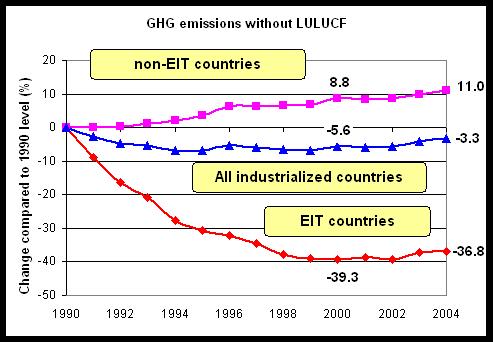 The Stern Report (below, or try the 30 pt size headline in the Globe and Mail just maybe trying to send a message to the Canadian government) arguing that the benefits of taking serious action on climate change far outweigh the costs, could not have been released at a more important time.
The latest GHG emissions data from the UN Framework Convention on Climate Change finds that emissions from most industrialized countries, including most Kyoto signatories, have increased in the past five years. The graph on the right shows the total GHG emission from 1990-2004 from all industrialized countries (ie. Kyoto signatories plus go-it-aloners like Australia and the US) separating out the EIT ("economy in transition") countries that were members of the former Eastern Bloc. The graph shows that GHG emissions have decreased slightly from industrialized countries since 1990 (3.3%) but largely only because of the dramatic drop-off in emissions after the break-up of the Soviet Union (36.8%). With emissions are now on the rise in most EIT countries like Russia, emission cuts by non-EIT countries (Europe, Japan and, ahem, Canada) is likely the only way to make up the difference between current emissions (3% below 1990) and the overall Kyoto target (5% below 1990).
Will it happen? If so, the leadership will come from Europe, and the Stern Report could play a huge role. Many European countries could be influenced heavily by the Report, the efforts underway in the UK (14% reduction, one of the few success stories) and the pledge of leadership on climate change from soon-to-be British PM Gordon Brown.
Canada, well, not only are reductions unlikely under the current plan, that plan may be influencing the decisions of other countries. Japan is 14% off its Kyoto target (of 6% below 1990 levels) and struggling with the decision to force mandatory emission cuts; as one Japanese official told Reuters, "Japan can meet the target if they implement extremely unpopular mandatory policies, but the question is why they have to when others don't seem to be really serious".
Check out the UN FCCC site for all the data.
British release report on economics of climate change
The British report arguing that the economic benefits of "strong, early action on climate change outweigh the costs" was released today. For full coverage, check the BBC. As I mentioned Friday, this is not just another economic study. The British government expects it to influence domestic and possibly international policy.
In a fine display of timing (sarcasm optional, perhaps it was intentional?), the NY Times has a front page story reporting that spending on energy technologies by both government and industry has been falling.
Friday, October 27, 2006
Uncertainty and the new EPA climate change site
The EPA has revamped its climate change web site.
Before you recoil in horror at the announcement, and wonder when the NY Times expose is coming, take a look. I feel the past and future climate change sections lean too much on the wording of a 2001 NRC report cautioning about natural variability in the climate system, especially given more recent reports by the National Academies. Otherwise, it seems reasonable. I'd be curious to hear other impressions.
And, hey, at least the EPA has a climate change site. Environment Canada is still posting this.
UK Report on the economics of climate change to be released Monday
A "stark" report about the economic costs of climate change will be delivered to the Royal Society in the UK on Monday. It is hard to predict how much "play" the report will get here, given the 24-hour coverage of the upcoming elections (or should I say coverage of polls and campaign ads? US election campaigns seem to have officially devolved to something akin to the TV networks battling it out for viewers during sweeps week, more on that later) but the details of the report should be all over the international news.
From the Independent:
In a preview of a report he is to deliver next Monday, Sir Nicholas [Stern] told the Cabinet the world would have to pay 1 per cent of its annual GDP to avert catastrophe. But doing nothing could cost 5 to 20 times that amount. He told them: "Business- as-usual will derail growth."
The massive 700-page report - commissioned by the Chancellor, Gordon Brown - was described as "hard-headed" and "frighteningly convincing". It focused on the economic peril now confronting the world, unless action was taken to combat harmful CO2 emissions that contribute to global warming.
"He left no one in any doubt that doing nothing is not an option," said one Whitehall source. "And he stressed that the need for action was urgent."
His review could be a watershed in overcoming scepticism about the existence of global warming. "It was hard-headed," said another source. "It didn't deal in sandals and brown rice. It stuck to the economics."
Mr Brown believes it could force the oil-dominated White House of George Bush to concede the importance of action to curb climate change. One minister who was present said it destroyed the US government's well known argument that cutting carbon emissions was bad for business.
His report, covering the period up to 2100, warns that climate change could cause the biggest recession since the Wall Street Crash and the Great Depression. A downturn of that magnitude would have "catastrophic consequences" around the globe, with the poorest countries hit first and hardest, Sir Nicholas told the Cabinet. Insurance analysts, who submitted their evidence for his report, said they feared insurance claims could exceed the world's GDP.
The report itself should be available here.


