Last week, a group of us Google Science Communication fellows sent a letter to the Chairman and CEO of the Google, pasted below, expressing our disappointment that the company held a fundraiser in support of Oklahoma Senator James Inhofe.
Our reaction to news of the fundraiser was a mix of confusion and shock. We were brought to Mountain View in 2011 to learn how new technologies could improve science communication, with a focus on climate science. Raising funds for someone who has openly threatened climate scientists, mocked scientific practice and tried to impede scientific progress was completely incongruous with the conduct of the company we visited two years ago.
I urge people not to succumb to cynicism - "that's business" - about Google's actions. This is an opportunity. Google has made a mistake. Let's bring attention to that mistake, and ensure Google, and other companies, don't repeat it. As four of my colleagues wrote at Dot Earth:
Responsibility, however, also rests with scientists, civil society
leaders, and the public. Indeed, this may be the enduring lesson of
Google’s mistake. By speaking out when our admired companies and
political leaders let us down, we are the only ones who can create the
conditions where the morally right thing to do is also good for politics
and business.
How do you speak out?
If you work for Google, sign the virtual petition at coworker.org asking your employer to stop raising money for Senator Inhofe and others who obstruct and deny science. If you know people who work for Google, bring the petition to their attention.
----
Eric Schmidt (Executive Chairman) and Larry Page (CEO)
Google Inc.
1600 Amphitheatre Parkway
Mountain View, CA 94043 USA
August 1, 2013
Dear Dr. Schmidt and Mr. Page,
Google has earned its reputation as one of America’s most innovative and forward-thinking companies, and has shown climate leadership by improving its own environmental performance and investing in clean energy technologies. That’s why it was deeply troubling for us, as Google Science Communication Fellows, to learn about Google’s July 11, 2013 fundraiser supporting Oklahoma Senator James Inhofe’s 2014 re-election campaign.
Among his most notorious statements, Senator Inhofe has outrageously claimed that climate change is "a hoax on the American people" and, in the absence of a shred of factual evidence, accused climate scientists of being "criminals."
The reality that human activities are causing major disruptions to our global climate and that these disruptions pose serious risks to society is accepted by virtually every climate scientist and by the world’s leading scientific organizations. Yet for more than a decade, Senator Inhofe has attacked and demeaned the very scientists who have worked tirelessly to better understand the threat and to warn us of the risks posed to the environment, our communities, and our children.
In the face of intensifying heat, rising seas and extreme weather, corporate leadership and private sector innovation will be essential to developing clean energy technologies and implementing more sustainable business practices. So too will be political dialogue, bipartisanship, and cooperation. That’s why we’re strongly supportive of the outreach efforts of former Republican Congressman Bob Inglis, who today leads the Conservative Climate Coalition.
Yet sadly, over the past decade, the polarization and gridlock that has derailed efforts to address climate change owes much to Senator Inhofe, who by relentlessly attacking the scientific community has undermined efforts at cooperation and consensus building.
Given Google’s commitment to educating the public about climate change, why would the company align its political efforts with Inhofe? In responding to criticism, a Google spokesperson acknowledged “while we disagree on climate change policy, we share an interest with Senator Inhofe in the employees and data center we have in Oklahoma.”
But Inhofe's assault on the scientific community is not a difference in climate policy; it's a strategy designed to promote dysfunction and paralysis; to destroy the reputation of scientists and the legitimacy of their institutions; and to undermine our ability to find common ground.
Such a strategy conflicts with the data-driven, problem solving culture that has enabled Google’s business success and is arguably contrary to its corporate philosophy of “Don’t Be Evil.”
In 2011, as participants in Google’s science communication fellows program, we witnessed first hand the company’s unique culture. At its Mountain View headquarters, we were introduced to new communication technologies and strategies for effectively translating climate science to a broad audience.
At the time, we were proud to be part of Google’s investment in science education; inspired by the creative, talented, and passionate people we met; and eager to apply new tools and strategies in our public outreach activities. But Google’s recent support for Senator Inhofe forces us to question the company’s commitment to science communication and to addressing climate change.
Nearly every large company must – and should – work with policymakers on both sides of the aisle. We also recognize the difficulty that corporations sometimes face in reconciling their core principles with their short-term business priorities.
But in the face of urgent threats like climate change, there are times where companies like Google must display moral leadership and carefully evaluate their political bedfellows. Google’s support of Senator James Inhofe’s re-election campaign is one of those moments.
The Signatories were all Google Climate Science Communication Fellows in 2011:
Brendan Bohannan, Professor, Environmental Studies and Biology, University of Oregon
Julia Cole, Professor, Geosciences and Atmospheric Sciences, The University of Arizona
Eugene Cordero, Professor, Department of Meteorology and Climate Science, San Jose State University
Frank Davis, Professor, Bren School of Environmental Science and Management, University of California, Santa Barbara
Andrew Dessler, Professor of Atmospheric Sciences, Texas A&M University
Simon Donner, Associate Professor, Department of Geography, University of British Columbia
Nicole Heller, Visiting Assistant Professor, Nicholas School of the Environment, Duke University
Brian Helmuth, Professor, Department of Marine and Environmental Sciences and School of Public Policy and Urban Affairs, Northeastern University
Jonathan Koomey, Research Fellow, Steyer-Taylor Center for Energy Policy and Finance, Stanford University
David Lea, Professor, Dept. of Earth Science, University of California, Santa Barbara, CA
Kelly Levin, Senior Associate, World Resources Institute
David Lobell, Associate Professor of Environmental Earth System Science, Stanford University
Ed Maurer, Associate Professor & Robert W. Peters Professor, Civil Engineering Dept., Santa Clara University
Suzanne C. Moser, Director, Susanne Moser Research & Consulting and Social Science Research Fellow, Woods Institute for the Environment, Stanford University
Matthew C. Nisbet, Associate Professor, School of Communication, American University, Washington D.C.
Whendee L. Silver, Professor of Ecosystem Ecology, Department of Environmental Science, Policy, and Management, University of California, Berkeley
Alan Townsend, Professor, Institute of Arctic and Alpine Research and Department of Ecology and Evolutionary Biology, University of Colorado Boulder
Note: Affiliations are for identification purposes only and do not imply endorsement by an individual’s institution or organization.
Monday, August 05, 2013
Ask Google to stop supporting Senator Inhofe and others who deny and obstruct science


Tuesday, July 16, 2013
Has global warming continued?

That we need to stop. Let's flip this around: "Has global warming continued?"
Yes. Global warming continues along, as this nice graphic from Climate Nexus shows so clearly.
The confusion is about surface temperatures. Over the past 10-15 years, the global mean surface air temperature did not increase at the rate of the previous decades. The cause of the slowdown is primarily natural variability, variability that is driven by long-term oscillations in the oceans. The planet is still adding heat - we can see in this planetary energy balance data. The difference is for the past few years, more of that heat is gathering in the deep ocean.
In a few years, the yin of deep ocean heating will give way to the yang of surface temperature warming. Among other things, we'll see full El Nino events develop again - there has not been one since the climate shifted in 1998, something my lab is studying - and with that, new global surface temperature records.
Thursday, July 11, 2013
This is what you call extreme weather, Toronto edition
The thunderstorms in Toronto earlier this week broke that city's seemingly unbreakable one-day rainfall record, set in 1954 by the meteorological oddity known as Hurricane Hazel.

Monday, July 08, 2013
New videos on Communicating Climate Science
The videos from the AGU Chapman Conference on Communicating Climate Science are now available.
There are several great talks on the history of climate science, effective and ineffective public engagement programs, and the research on why we sometimes struggle to explain the basic science outside the classroom. Among my personal favourites was John Calderazzo's talk on the importance of storytelling.
Here's my contribution, on how the climate influences the way we think about climate change, both at home and abroad:
Wednesday, June 26, 2013
Awaiting a Canadian response to Obama's climate speech
For about a decade, the explanation for a lack of coherent Canadian climate policy was the lack of a coherent American climate policy. How could our federal government move forward with actions like regulations, carbon pricing, renewable portfolio standards, international agreements or adaptation plans without our largest trading partner and BFF?
This argument was literally encoded in Canadian policy by the current government (see page 15):
Given the degree of economic integration with the U.S., we are aligning
our climate change approach with that of the U.S. as appropriate, to
maximize progress on reducing emissions while maintaining economic
competitiveness
Now the U.S has a plan. No, it is not perfect, but it is far more advanced than any plan proposed by any sitting President or Prime Minister.
The ball is in our court. Time for Canada, time for Canadians, to define "as appropriate".
Wednesday, June 19, 2013
Some of Rolling Stone's "10 Dumbest Things Ever Said About Global Warming" are not so dumb
There's no shortage of dumb things said about global warming. Compiling a list of the ten dumbest requires wading though thousands and thousands of inane extrapolations about climate change impacts, butchered explanations of the physics of the climate system, and downright wacky U.S. congressional testimonies that seem to come from an alternative universe. There was an entire "global warming movie", the Day after Tomorrow, featuring storms that defied the laws of thermodynamics.
Given the full panoply of options out there, it is disappointing to see Rolling Stone's new top-ten list feature the following two entries:
4. Climate change is impossible because "God's still up there."
8. Safeguarding the climate is "a worldview that elevates the Earth above man."
These may seem dumb to people who read Rolling Stone, but not to many other people on the planet.
The entries are based on quotes from religious conservative American politicians, all of which essentially argue the climate is outside the human domain. As I've documented multiple times, the view that the
climate is beyond human control is not radical. If you take a historical perspective, the opposite is
true. The fact that we can change the climate is a relatively new concept, one that counters thousands of years of human culture and belief.
These two of the "dumbest" things are also not unique products of the politicized Western climate change debate. Here's an example from #4:
A close runner-up in this category: In 2009, Rep. John Shimkus (R-Illinois) cited God's post-flood promise to Noah as evidence we shouldn't be worried. "The Earth will end only when God declares it's time to be over," he declared.
Rep. Shimkus' argument about the flood is not an invented Republican talking point. The same argument about the covenant between the Biblical God and Noah (that the seas will not rise again) is made by many elders in Tuvalu and Kiribati, when told that human activity is making the sea rise.
Certainly, we need to fight wholly incorrect statements about climate change. It is important that people appreciate the fake, uncritical and often organized skepticism about climate change out in the ether. And, sure, it is possible that the statements by Rep. Shimkus and the others fall into that category; maybe the statements were carefully designed to tap into the audience's beliefs.
Regardless, many people in many countries honestly agree with those statements. You don't engage new audiences by mocking their core beliefs.
Monday, June 10, 2013
Follow the AGU Chapman "Communicating Climate Science" conference online

It is not an empty gesture. The organizers are trying to mix in questions from the online viewers, sent either via the meeting web-cast site or using the twitter hashtag #climatechapman.
A number of people here, Gavin Schmidt, myself and others, are also tapping out live tweets during the sessions.
Tuesday, June 04, 2013
America's big three: corn, soybeans and wheat
Last night, after a scare from the tough Indiana Pacers, the Miami Heat's "big three" of LeBron, Wade and Bosh advanced to the NBA Finals.
Unlike the other major North American sports, in basketball, it is possible for teams with just three great players to dominate. In baseball, football and hockey, with dozens of players per team each with very defined roles, the presence of three great players alone won't get you to the championship.
 U.S. agriculture is a lot like basketball. Over the past few decades, the big three of corn, soybeans and wheat have come to dominate U.S.
agricultural land. Yet, as in basketball, the basic parameters of the game have not changed. The court - the amount of land used to grow crops - is the same size it was back in the 1930s, despite the players getting larger and more skilled.
U.S. agriculture is a lot like basketball. Over the past few decades, the big three of corn, soybeans and wheat have come to dominate U.S.
agricultural land. Yet, as in basketball, the basic parameters of the game have not changed. The court - the amount of land used to grow crops - is the same size it was back in the 1930s, despite the players getting larger and more skilled.
This spring, planting of the big three crops
account for an estimated 231 million acres of agricultural land. That is, by my estimate from USDA data, roughly two-thirds of all cropland, and 87% of cropland devoted to major crops (i.e. not fallow or idle). Outside of brief soybean-driven surge in the early 1980s, there is currently a greater amount and proportion of cropland being devoted to corn, soybean and wheat than ever before. The current surge is driven largely by the use of corn for ethanol, as well as the continued demand for soybean and corn for animal feed.
The Heat's opponent in the Finals are the San Antonio Spurs. Though the Spurs have their own big three - Duncan, Parker and Ginobili - the team is best known for its tough coach who makes use of every role player on the bench. It is a true clash in styles. I'll be curious to see who wins.
Monday, June 03, 2013
How scientists can talk about public policy

After opening with a discussion of my own path to research on climate change and coral reefs, we go into details on the value of adopting a 'scientific' approach to policy judgements, the risk of 'stealth' issue advocacy (a term coined by Roger Pielke Jr.), the benefits of communications training, and the importance of engaging with the public without disengaging from science.
Wednesday, May 29, 2013
Kiribati's battle against sea-level rise: the perception and the reality
Last year, I published an article (Donner, 2012) reflecting on years of field work in Kiribati:
Tarawa, the most easily accessible atoll in Kiribati, is a popular destination for journalists and activists interested in observing and communicating the impacts of sea-level rise on a low-lying nation... common images of flooded homes and waves crashing across the causeways—collected during an anomalous event on islets susceptible to flooding due in part to local modifications to the environment—can provide the false impression that Tarawa is subject to constant flooding because of sea-level rise.
 |
| Kiribati's Abaiang Atoll (photo by author) |
Such unverified attribution can inflame or invite skepticism of the scientific evidence for a human-caused increase in the global sea-level.
I now bring you Exhibit A: "Kiribati: A Nation Going Under" by Bernard Lagan in the Kiwi publication the Global Mail, published a couple weeks ago when I was in the field.
Running out of options, and water, a nation’s leader enters an end game against climate change. The President of Kiribati urges an orderly evacuation — “migration with dignity”.
Rare among international coverage of Kiribati, the article goes into accurate detail about the many local issues beyond climate change and is tough on President Anote Tong, who is usually lionized by the international press. Yet the article still butchers the evidence for impacts of sea-level rise, falling for the tempting bait I describe in the Donner (2012): flooding and erosion caused by climate variability and shoreline modification. It is a shame because otherwise, the article is one of few I've seen to capture the complex politics of responding to threats of climate change in this remote, developing nation.
Along comes Andrew Bolt, a skeptical writer from Australia. He does what I'll guess was a few minutes of research with Google, and then raises loud objections in the two bluntly-titled articles: "Are the satellites lying about poor drowning Kiribati?" and "Look at this other drowning island, the Global Mail writer insisted. So I did."
Most of Bolt's claims are ridiculous or sloppy. First, he tries to eyeball changes in Tarawa's land area using Landsat satellite imagery over a 12 year period. This would be like standing at the finish line of a 100 m race and trying to spot individual hairs on the heads of the sprinters in the starting blocks. Second, like many other journalists, he mistook reports that some islets expanded in area over past decades (Webb and Kench, 2010) as evidence that the islets are not being affected at all by sea-level rise. Think of it this way: islands can expand in surface area over time due to land reclamation and natural beach movement and still become "lower" and suffer saltier groundwater because the ocean is higher. Third, Bolt uses second-hand sources, citing selected text from a blog post on my work, rather than reading my work or dropping me a line.
Nonetheless, buried in the muck are some correct assertions, and the overall argument will come across as reasonable to many readers. The end result of an otherwise good Global Mail article is confusion about whether sea-level rise is affecting Kiribati.
How can this be avoided? More care in reporting about sea-level rise would help. The Global Mail article features three classic mistakes made by journalists and climate activists:
1. People are leaving a low-lying island so it MUST be a result of sea-level rise
Sea-level rise could very well lead to mass migration between atolls and from Kiribati to other countries. Is it happening now? The Global Mail:
But some outer islands are also being invaded by the sea. Their fragile fresh water reserves stored naturally beneath the ground are dying away and more and more displaced outer islanders are flocking to Tarawa.
Lagan's repeating an assertion commonly made by climate activists in and out of Kiribati. In reality, migration to Tarawa is driven largely by Kiribati's transition to the cash economy and the desire for jobs, as Bolt correctly asserts in his article. This is no secret; the same dynamic is at play in many developing countries. And had Lagan done some digging, he would have found that freshwater pressure on outer islands has always existed; people voluntarily evacuated in the 30s and 40s from the Southern Gilberts.
2. Land is eroding, so it MUST be because of sea-level rise
Sea-level rise will certainly erode Kiribati shorelines. But not every case of erosion you are shown in a short visit to Kiribati is actually due to
 |
| El Nino driven flood of 2005 (photo by auth |
Elsewhere on Abaiang Atoll, one village, Tebunginako, which villagers have battled to save for the past 30 years from the encroaching sea, has had to be moved inland — a development that is often referred to as hard evidence that Kiribati is being ravaged by climate change.
Ask yourself a question. If atolls feature long narrow strips of land, why would one village erode away by tens of metres more than the neighbouring villages? A quick internet search is all that's needed to uncover the very clear 2005 report by the South Pacific Applied Geoscience Commission (SOPAC) about Tebunginako. The village was built long ago on the sand spit created by a former passage between the lagoon and the outer island. It's eroding because of "shoreline processes consistent with an ocean / lagoon passage". Village consultations were done, and the evidence was accepted, as it agreed with the local oral history. People agreed that given the land was naturally eroding, it made more sense to move their homes than to build sea walls.
3. A weather extreme affected the shoreline, so the extreme MUST be caused by climate change
Once again, the Global Mail:
Yet, as far back as 1992, a technical report, funded by the Canadian government, said increasingly severe El Niño events were producing the large waves that were eroding the Abaiang coast... Only very recently — in the past year or two — have some climate scientists begun to suggest a strong link between severe El Niño events and global warming. However, this link is still contested among scientists.
In this case, it is worth talking to a climate scientist about El Nino events. Weather and high seas during El Nino events certainly lead to wave inundation in Kiribati, an issue I discuss in depth in Donner (2012). The El Nino driven variability in sea-level, ocean temperatures and wind direction is one thing that makes Kiribati so unique. Unfortunately, the desire to blame the El Nino inundation events on climate change has driven most of the flawed international coverage of climate change in Kiribati. Though flooding during already high water El Nino events is certainly statistically more likely to happen as global average sea-level rises, the events themselves are no more evidence of rising sea-level than an individual heat wave is evidence of rising global temperatures.
What to do
Climate change is frustrating. Though unprecedented in recent geological history, human-caused climate change still operates at too slow a pace to capture much of the public's attention. So people try to attribute current events to the long-term trend, and often make elementary mistakes: I'll end with my recommendation from my article:
Instead of incorrectly attributing individual flood events or shoreline changes to global sea-level rise, scientists and climate communicators can use such occurrences to educate the public about the various natural and human processes that affect sea-level, the shoreline, and the shape of islands. This would better prepare the public and policy makers for the changes that societies are likely to experience as global sea-level rises in the coming decades.
So journalists and climate activists: Before and after you go to Kiribati, or Tuvalu, or the Maldives, please call a scientist that works there. It will save us all a lot of trouble.
Thursday, May 09, 2013
The letter to Minister Oliver from climate scientists and energy experts (en francais)
Tuesday, May 07, 2013
Talking about climate change in a hot and cold world
There's been a small burst of skepticism about the science of climate change in the media in the past few months, as if arguments usually confined to dark corners of the internet oozed out into the hallway. This was encapsulated in the
well-researched but misleading article in the Economist that suggested the climate may be much less sensitive to greenhouse gases than previously thought. This emergence of skeptical arguments in the public realm is in sharp contrast to last fall, when concern about climate change was supposedly increasing, both among the media, and in opinion polls.

For one, the weather.
Last winter, central and eastern North America bathed in record heat, including cases where March temperature records were broken by 8 degrees Celsius. That was followed by the warmest summer in U.S. history [and, in the fall, by the sea-level rise assisted storm surge from Hurricane Sandy].
Consider this quote about the U.S.:
By July... there were cover stories in news weeklies, lead articles on broadcast news programs, and hundreds of newspaper and magazine writeups appearing on the presumed connection between the heat wave and the greenhouse effect. With a few exceptions, there was very little scientific content in most of the stories. Instead, dramatic visuals of damaged crops, dried up rivers, sweltering cities, record hurricane pressures, or burning forests dominated the coverage...
Unlike last year, this winter and early spring was cold and snowy across central and eastern North America as well as much of Europe, regions that happen to be home to much of the world's English-language prestige press, not to mention most of the loud voices on climate change.
A recent paper by my former student Jeremy McDaniels and I found that American attitudes about climate change tend to follow the weather. Analysing polling data and newspaper op-ed content from 1990 through 2010, we found that after periods of unusual warmth, people tend to be more convinced and more concerned about climate change. Conversely, after unusually cold periods, people's views tend to go in the opposite direction.
Let's be clear: The relationship detected in our paper does not necessarily mean that people confuse weather and climate, concluding after a cold winter that, say, global warming has stopped. The cold period may directly or indirectly lead people to revisit a meme about slowing of global warming. And it's impossible to say with any level of certainty whether this dynamic has played an important role, or any role, over the past few months. We're talking in loose terms about a single data point, and a fuzzy one at that.
Plus, I have misled you about one thing.
That quote? It was not actually from last year. It is from a 1989 Climatic Change editorial by Steve Schneider about the summer of 1988. It continues:
Better stories pointed out that there was some debate as to whether anyone could ascribe the weather events of one year to a global trend. After all, the drought in May and June was a result of an out-of-position jet stream, which diverted storms up into Canada rather than across the mid-United States... But most coverage, especially on television, had little discussion that reflected the consensus of views on what is well accepted and what is deemed speculative by most researchers. Mostly, the association of local extreme heat and drought with global warming took on a growing credibility simply from its repeated assertion.
Sound familiar? Schneider was worried about how scientists should talk about human-caused climate change in light of the natural variability in the climate. If we talk only about the "signal" and ignore the "noise", we are not being completely forthright, and we risk confusion down the road.
Therefore, my excitement at the long-overdue public attention the greenhouse affect was finally receiving was tempered substantially by a fear that should next summer be anomalously cold and wet - by no means a remote possibility - not only could we lose the momentum of public interest, but some of our credibility as well.
Rather than just blame the media for the swings in coverage and public opinion, scientists and all the climate "activists" should recognize that they may also be at fault here. There's so much effort to talk about climate change during the heat waves, that it can create a backlash during cold spells.
The message of climate change is one of a signal emerging from the noise. Perhaps we need to talk about the signal at a more constant rate over time, rather than let our communications efforts go up and down with the noise.
Tuesday, April 30, 2013
Engaging the public without disengaging from science
Today, COMPASS published a commentary in PLOS Biology
on the journey from science outreach to meaningful engagement. This post
is part of a series of reactions, reflections, and personal experiences
we hope will expand the conversation. Read the summary post here, or track the conversation by searching
for #reachingoutsci
A few years ago, I found myself at a retreat with a group of highly accomplished scientists from around the continent. Why, I don't know. I suspect my invitation came much as it would to a team's equipment person, who are still needed during practice drills on the road to fetch all the loose balls.
On the penultimate evening, the discussion turned to the challenge of balancing science and outreach. The very unscientific activities of the retreat had wore down the competitive academic armour that most successful scientists wear like second skin, and revealed a surprising vulnerability among the group. Most everyone held an existential fear of this mysterious force, which most often went by the moniker "they".

I delivered an eloquent speech about the psychological legacy of years spent jumping though hoops in the hierarchical academic world and how the greatest obstacles we must overcome in life are often internal. Either that or I channeled old-country centenarian grandmother and said "What the %$@* are all of you talking about?". It's been a few years, so I don't recall the exact wording.
It is healthy for a scientist to be cautious about outreach. Really.
Yet there’s a big misconception among young scientists that "the academy" frowns upon those who engage with the public. Speaking up is not the issue. What scientists really frown upon is simply people who don’t know their stuff. If you're consistently good at your job, you really can talk to the public without fear of serious recrimination by your peers.
Those doing outreach might experience some backtalk, but so might those who get teaching buyouts from a grant, win external fellowships or publish in general science journals. Some of that is jealousy. The politics of academics are a lot like that of junior high, except it is a unique junior high for Type A adults who studied too hard in actual junior high to fully graduate past that stage of psychological development. I keed, I keed. Sort of.
I think the key to managing the balance between science and outreach in the competitive research world is to be a good scientist. And, by this, I mean two different but related things, things that I wish I had been told years ago:
1. Before even thinking about outreach, you have to do your job and do it well. That means publishing in top journals, being cited by others, the whole ball of statistically significant wax. Why should anyone outside of scientist listen to a scientist who is not consistently doing research that is respected by others in the field? And respected, does not mean loved. People respect research that is thorough and well-supported, even if they disagree with the findings.
2. We're scientists, why not be scientific about outreach. Be systematic. Do research on the role of scientists in society. Evaluate different methods and assumptions. And when the time comes, be precise.
Be harsh - with yourself
To be scientific about outreach, you need to be extremely harsh with yourself about why you are getting engaged beyond the scientific world. I cannot stress this enough, I did not think about this nearly enough before starting this blog.
What values are motivating your engagement, and how are those values affecting the public statements you plan to make? It is perfectly acceptable to advocate. We are citizens, we have every right to express our views. However, if we are not clear with people about when you are making a scientific or "objective" judgement (i.e. our analysis shows climate change will lead to an increase in coral bleaching) versus a value judgement or a "should" statement (i.e. we "should" reduce greenhouse gas emissions), then we are only doing harm to the overall scientific enterprise.

This means it is critical to think very carefully about who you are representing when you deal with the public or policymakers, be it in a public seminar, a policy hearing or a blog post. Are you speaking on behalf of your specific new research? Your greater body of work? Your field? Or "science"? Always keep in mind that while you may think you are speaking on behalf of your own research, the audience may think you are speaking on behalf of "science". Sometimes highlighting an anomalous result, like a resilient coral reef that is an exception to the global rule, can end up misleading the public.
Looking back, I'm glad that the scientists at the retreat were a bit reticent about outreach, even if I think the reasoning was wrong. If I've learned anything from my interactions with the folks at COMPASS and other science-public intermediaries, it is that we should be cautious about outreach just like we are cautious about research. We want to do both well, don't we?
Thursday, April 25, 2013
Who is right about the oil sands: James Hansen, Joe Oliver or none of the above?
Years ago, when I was on the editorial board at the Silhouette,
McMaster University's campus weekly, we received lots of letters to editor expressing outrage about some university decision. The vitriolic letters would invariably start with the phrase "I am appalled by", a phrase that was often bandied by the overtired editors trying to put the paper "to bed" at 5 or 6 am.
There was no shortage of outrage yesterday when Canadian Minister of Natural Resources Joe Oliver called out well-known climate scientist Jim Hansen during a speech in Washington. Oliver argued Hansen is "exaggerating" when he says exploiting the oil sands (thanks Brad) would be "game over" for the climate. Oliver laid out his argument in full later in the day during this follow-up interview on CBC's Power and Politics:
Should we be appalled by the Minister's statement?
This very issue was subject of a recent post, some of which is paraphrased here. In defending Keystone XL and the oil sands, Oliver quotes a much-discussed article published Neil Swart and Andrew Weaver that found the total amount of carbon stored in the
oil sands is "only" sufficient to raise the world's temperature by
0.24-0.50°C.
In that sense, what Oliver is saying is true, in that it does reflect the results of the Swart and Weaver analysis. Given that full extraction of the oil sands would take many many years, and that new pipelines like Keystone XL itself would only allow a fraction of the oil sands to be extracted, it would appear to be correct that any claim that expansion of the oil sands or building Keystone XL is directly "game over" for the climate is an exaggeration.
However, if you consider the oil sands as part of a particular energy future, Hansen's claim, though a bit hyperbolic for my tastes, does have legitimacy. (note: Hansen did not specifically say, in the original article, that the oil sands alone were "game over", but his comments since more or less support that assertion)
The figure below shows that according to International
Energy Agency (IEA) modeling, if all of the oil sands projects with
regulatory approval go ahead, oil sands production will exceed the level
expected to occur in a +2°C world. If the projects under regulatory
review all go ahead, oil sands production will be higher than that in
the IEA's +6°C scenario.
 |
| The first column is existing, planned and announced oil sands projects; the orange bars are oil sands production in the IEA future scenarios. Production is assumed to be 80% of capacity, following the IEA methods. |
Regardless of whether the carbon in the oil sands should be directly considered "game over", the IEA Outlook suggests a world with greater oil sands extraction is, in essence, a "game over" in Hansen's mind, because it would guarantee dangerous impacts from climate change (e.g. eventual loss of the major ice sheets). If we want to avoid Hansen's "game over", we probably need a global energy system in which the expansion of extraction in the oil sands is constrained. Since the proposed pipelines like Keystone XL would allow for construction of the extraction projects with regulatory approval or under regulatory review, blocking the pipelines might be the best indirect way of leaving most of that carbon in the ground.
 In the end, round one of Oliver v. Hansen says more about overly cartoon-ish discussion about climate change, than it does about the climate science and the oil sands. Oliver's argument has some merit. So does Hansen's. Rather than deal with the grey, we force all this into black and white. Outspoken scientists are messiahs. Conservative politicians are oil-soaked, climate deniers. It makes for great video and easy outrage on twitter. It does not advance the conversation or lead to any solutions.
Communications and the media have come a long way since those long nights at the Sil, where we laid the paper out by hand on big boards, carefully pasted single words into articles to correct mistakes, and used RP tape (black lines) to create edges on the photos.
Letters begat emails. Emails begat blog posts. Blog posts begat tweets. People are still appalled, but now in 140 character bursts.
Tuesday, April 16, 2013
How not to report about climate science
Exhibit C: Early 21st Century Science Reporting
Reminder: Please do not lean against the glass.
April 7, 2013 (Reuters) - Climate change could get worse quickly if huge
amounts of extra heat absorbed by the oceans are released back into the
air, scientists said after unveiling new research showing that oceans
have helped mitigate the effects of warming since 2000.
April 16, 2013 (Reuters) -
Scientists are struggling to explain a slowdown in climate change that
has exposed gaps in their understanding and defies a rise in global
greenhouse gas emissions.
Description:
The previous exhibit showed that, in the early part of the century, science reporting often suffered from a problem popularly known as "balance as bias". The journalistic norms of reporting on both sides of the issue led some writers to give equal space to voices representing the bulk of the science community on subject like climate change as to voices representing a few outliers in the science community or industry groups opposed to action on climate change.
This exhibit displays a more egregious reporting error. In the Reuters' article from April 16, 2013 entitled "Climate scientists struggle to explain warming slowdown", the reporters not only failed to interview any climate scientists at all on the subject of the supposed struggle, they failed to check recent articles from their own organization.
NOTE: The apparent slowdown in warming described in the April 16 article may not be familiar to many visitors to the museum. It is, in fact, visible in the global temperature record over the past two centuries if you increase the resolution on your e-glasses, ignore the multi-century warming trend, and focus on the decade in question.
Monday, April 08, 2013
Can climate science live up to expectations?
There's a huge demand for local and regional climate projections. Policy-makers, planners and everyday people all over the world are looking for scientists to provide "data" on the future climate of their region, their town, their coast, their water supply, in order to better inform long-term decisions.
This demand is captured by the fast-spreading concept of climate services. In the past few years, there have been many new national and international initiatives and forums, like the recent Pacific Islands Climate Services Forum, aimed at getting scientists, government agencies and the private sector to "supply" these services.
 |
| Pacific Islands Climate Services Forum (Jan 2013) |
The recent RealClimate post on regional climate modelling illustrates the size of that gap. In short: a couple recent publications, summarized in Science (Kerr, 2013), question the effectiveness of the regional models based on comparison analysis of model output and climate observations. The RealClimate post rightly takes the articles to task, reminding everyone that no climate model, regional or global, should be expected to recreate the exact year-to-year variation in the weather. The system is too chaotic and sensitive to the initial conditions in the model. So models can describe the frequency and magnitude of climate variability, but "these fluctuations are not synchronised with the real world."
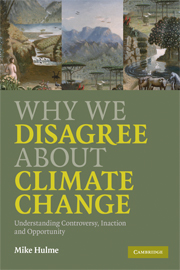
This confusion is an example of a gap between what science can deliver and what people expect science to deliver, as Mike Hulme discusses in Why we disagree about climate change?.
The gap is common with climate change science, but hardly unique to climate change science. Think of going to the doctor with a sprained ankle. You hope for a clear diagnosis and timetable for recovery. Instead, you receive a vague answer on a simple three point scale about the severity of the sprain, and a range in weeks for the likely recovery time.
 The expected recovery time from the sprain is the medical equivalent of a multi-model ensemble prediction: we can't tell you exactly when the ankle will heal or how much the climate will change, but we can tell you given the input data, it "should" occur in this range. It is, statistically-speaking, possible that it will not occur in that range, because there is a chance that the data on which that range was based did not capture 100% of the range of possible experiences.
 As a patient worried about being able to walk, you quite likely to want the "expert" to do more definitive tests to improve the answer. However, the high-technology test, be it a MRI or a new climate model, are not guaranteed to radically improve the diagnosis of what's happened or the future prediction. This is simply not something we can know with 100% confidence and 100% certainty.
Many of the potential users of climate change projections, not educated on the fine technical points of climate modelling or statistics, are often looking for precise answers that scientists and our models will never be able to provide. This expectation is embedded in the very language that is used. At the Pacific Islands Climate Services Forum in January, I was told many times about the need for "data", a word I've intentionally place in quotes in this post, for decision-making. The word "data" implies a precise measurement. Yet what scientists can provide is a "prediction", which comes with uncertainty, itself a combination of known and unknown elements
It is clearly important to develop and properly evaluate methods for regional climate prediction. Even with the uncertainty, some of which is irreducible, in future predictions, the information can still be of use in decision-making. We are, after all, able to decide whether it is safe to start running again after an ankle sprain, despite imperfect knowledge on the exact state of the ligaments, muscles and tendons.
Scientists, however, need to recognize the core challenge is not just improving models, but improving understanding of what can be modelled. Otherwise, scientists and decision-makers will be at cross purposes.
If you're interested in more of these ideas, I recommend the third chapter - "Performance of Science" - of Hulme's book. I assign it to my undergraduate students every year.
Thursday, April 04, 2013
The Vancouver Accord: Reaching international agreement on climate policy, in class
The students in Geography 312 (Climate Change: Science and Society) just completed a mock UN climate summit.
Like the real UN Framework Convention on Climate Change meetings, the detailed negotiations were contentious and concluded with
only minutes to spare.

Unlike the real UN Framework Convention on Climate Change meetings, the students managed to forge some creative and very detailed solutions to avoid stalemates over long-term action to address climate change.
Without further adieu, I present the 13-part Vancouver Accord, composed and agreed to by 65 negotiators from 21 countries.
VANCOUVER ACCORD – OUTCOME OF THE MOCK 19th CONFERENCE OF THE PARTIES TO THE UN FRAMEWORK CONVENTION ON CLIMATE CHANGE
1. The parties to this convention agree that the climate change represents a dire threat to the ecological and economic future of the planet. The parties agree that greenhouse gas concentrations in the atmosphere should be stabilized at a level that would avoid dangerous anthropogenic interference with the climate system and the wellbeing of people and economies worldwide.
2. The aspiration of the long-term cooperative action is stabilization of greenhouse gas concentrations in the atmosphere at level that will keep global warming at minimum below 2° C above pre-industrial levels, currently expected to be 450 ppm CO2 equivalent, and possibly below 1.5°C above pre-industrial levels. The concentration goal will be subject to later review, based on the best available science, including the climate sensitivity.
3. The parties agree with the notion of common but differentiated responsibilities, based on recent greenhouse gas emissions and the unique circumstances of each nation, towards this goal.
4. Following this notion, the parties agree to consider legally-binding emissions targets for 2020, with recognition that medium-term targets for 2030 and long-term targets for 2050 should be considered as part of the 2015 agreement on long-term co-operative action.
5. These proposed CO2 equivalent emission targets, pending agreement by all major emitters, may include:
• Canada: 18.5% below 2005 level by 2020
• EU (Germany, France, U.K.): 30% below 1990 level by 2020; 40% below 1990 levels by 2025, and 80% below 1990 levels by 2050
• Japan: 18.5% below 1990 level by 2020
• Norway: 40% below 1990 level by 2020
• Russian Federation: 18.5% below 1990 level by 2020
• U.S: 18.5% below 2005 level by 2020&
• China: 30% below 2005 level by 2040 provided other listed countries reach their targets for 2020
6. Commitments may be met by flexible measurements, to be proposed by the parties no later than the 2015 COP, and to be negotiated no later than 2017 in order to come into effect before 2020.
7. Flexible mechanisms may include bilateral and multilateral emissions trading and/or technology transfer agreements. The mechanisms will be monitored and managed by this convention. Examples include the Bilateral Offset Credit Mechanism created during these negotiations by Japan, in which Japan has reached agreement with each of Bangladesh, China, Germany, India, Maldives, Mali, Nigeria, Saudi Arabia, and Solomon Islands, on transfer of low-carbon technology or adaptation assistance in specific areas in exchange for emissions credits applicable to the 2015 agreement on long-term co-operative action and credit toward targets set for developed country financing to the developing world. Another example is a bilateral agreement between Germany and Saudi Arabia agree to consider mutual development of solar technology.
8. The parties recognize that youth will play a critical role in creating a sustainable, prosperous future for the planet. The parties will consider the creation of an International Youth Education Program on Climate Change and an annual Youth Initiative Conference where young representatives from all the participating countries will share their views and ideas and get educated about the ways to support sustainable future, developed to accommodate each country's unique circumstances. The program will operate under the Global Standard Education System. All the parties are required to submit an annual feedback to the system, and all the parties will be funded according to needs.
9. The Annex I countries present (UK, Germany, France, Norway, Australia, Japan, US and Canada) agree to have 30% of their national energy from renewable sources by 2030. This is dependent on the US and Canada agreeing on a reasonable improvement in technology transfer between the two countries. Japan has also asked for a flexibility following the Fukushima disaster. This agreement is legally binding if the above are achieved. The target will be shared within the EU, with goals of 25% for France, 30% for the U.K. and 35% for Germany.
10. A subset of the parties developed the “Agreement to Population Control for Least Developed Countries”. Bangladesh, Ethiopia, Chile, Indonesia, Australia, India, Maldives, and Mali have agreed to minimize population growth to 10-15% increase within the next 40 years. This agreement is non-binding, and requires external funding from the UN. Strategies for Population Control are included in the agreement.
11. A subset of the parties (Japan, U.S., Solomon Islands, Russia, Chile, Brazil, Australia, Bangladesh, Mali, Tuvalu, and India) agreed that the Green Climate Fund will be the most effective way to combat climate change in developing countries. Developing countries will accept a portion of short-term financing loans that will turn into long-term grants upon proof of results towards project goals (as determined by third party actors on behalf of the Fund Board). However, these countries stress that grants are ideal mechanisms for developing countries.
12. Under negotiations for REDD+, the parties (Australia, Bangladesh, Brazil, Chile, Nigeria, Solomon Islands, Indonesia, Norway, U.S.) agreed that by the 2014 COP to draft a conditional agreement on a standardized and transparent process of monitoring. The systems must be verifiable by international standards to ensure the consistency of emissions monitoring. The system will include:
• Establishment of adequate monitoring systems at either national level, or if the nation does not have the capacity have the option, with international or partner state assistance
• National standards for emissions reductions monitoring with the condition of transparency between countries through a standardized monitoring process.
• Regional incentives for countries without UN-REDD implementation at the national level with a goal to have programs implemented at the national level by 2020
Based on this conditional agreement on the standardized emissions monitoring, the parties will move forward to address additional funding schemes.
13. Following the REDD+ negotiations, at the upcoming COP in Warsaw, the parties will address setting up an international framework for the Green Climate Carbon scheme. This market-based climate scheme will expand the financial capacity of developing nations to reduce deforestation and forest degradation from anthropogenic emissions, while increasing incentives developed nations to fund the program.
COUNTRIES PRESENT FOR NEGOTIATIONS
Australia
Bangladesh
Brazil
Canada
Chile
China
Ethiopia
France
Germany
India
Indonesia
Japan
Maldives
Mali
Nigeria
Norway
Russia
Saudi Arabia
Solomon Islands
Tuvalu
United Kingdom
United States


