Sometime in the past year, whether due to Hurricane Katrina, a flood of new research, exasperation with the Bush Administration, the reception of climate change science changed dramatically. Global warming is happening, in every sense of the word.
It is heartening to see the subjcte receieve so much attention and especially to see new research now widely reported about in the popular press. Every week, some new research, about hurricanes or temperature records or tropical circulation or the vulnerability of coral reefs, bounces around the wire services and garners headlines in the daily papers.
There is some danger in the popularization of science. Critics of the particular research might argue that the scientists themselves being compromised by the chance at fame [hardly, the fame is pretty minor and fleeting, it’ll be a long time before we start seeing average post-docs on Letterman]. I'd argue the science itself is more likely to be compromised by media constraints.
The main challenge for scientists explaining their research to the press or the public is the sound-bite. Your two year study? We are told to boil it down to one pithy statement. So we respond by working with the public relations office at the university or research centre when a newsworthy research paper is published (e.g., to write press releases), or in some cases, to attend media-training seminars.
The problem with sound-bites of climate science is that they will often overstate the certainty in the findings. They then become politicized. The news clippings or remarks can get picked up by environmental or activist organizations, who may inflate the remarks. This makes easy fodder for the people commonly referred to as climate skeptics*. This is writ large on the blogosphere, which can operate like a large game of broken telephone, resulting in twisted interpretations of the science. The word “blogosphere” itself sounds like a ride at an amusement park, which, in many ways, it is (riding is not recommended for pregnant women, people with heart conditions, children under the age of 12, or fans of objectivity). This is part of the reason I started this site, why sites like realclimate.org are so valuable, and, in my mind at least, why we need to work heard to increase scientific literacy.
* For the record, while I find the arguments of most people skeptical of climate change un-scientific and clearly biased, I hate the cultish connotations, and the spelling of, the term “climate skeptic”. Yes, the overwhelming majority of the people publicly skeptical of climate change are not climate scientists and are either supported by industries with a vested interest, like coal and oil, or employ arguments framed by those supported by those industries. But the labeling of people makes the rest of us look petty and threatened.
Friday, June 30, 2006


Monday, June 26, 2006
Senator John Kerry delivered a strong speech about energy policy and global warming yesterday. Even if Kerry is merely ante-ing up on the issue (Al Gore's film, a speech by Hillary Clinton the week the film was released, but of course, no coincidence there), it is a terrific speech (text) and actual contains specific policy recommendations. Now, if only, a candidate can speak like this during an actual presidental election.
In the speech, Kerry mentions a "new" finding about temperature trends over the past 400 years. He is referring to the National Academy of Sciences report on the famous "hockey stick" graph, discussed below.
Last week, the US National Academy of Sciences published a long-awaited report on the "hockey stick". No, the report has nothing to do with the Stanley Cup finals, though feel free to draw a climate change metaphor from the Carolina Hurricanes beating the Edmonton Oilers.
The "hockey stick" is the famous graph depicting global temperatures over the past 1000 years; the blade of the stick is the upswing in temperatures since the Industrial Revolution.
The graph was originally produced from the instrumental temperature record (since 1860) and a collection of temperature proxies -- ice cores, tree rings, etc. -- for the period before widespread temperature measurements are available. It shows that the end of the 20th century was warmer than any other time in the past 1000 years. The authors of the original study also concluded that the 1990s was likely the warmest decade of the millenium, and that 1998 was likely the warmest year of the millenium.
The hockey stick has been the subject of legitimate - and much illegitimate - controversy. Many people skeptical of climate change have criticized, attacked may be more accurate, the methods used to reconstruct temperatures, especially for the period known as the Medieval Warm period (around 1000 AD).
At the request of the federal government, the NAS poured over the data. The report agrees with the general results of the original papers (you can read it all here):
"It can be said with a high level of confidence that global mean surface temperature was higher during the last few decades of the 20th century than during any comparable period during the preceding four centuries... Less confidence can be palced in large-scale surface temperature reconstructions for the period from A.D. 900 AD. Presently available proxy evidence indicates that temperatures at many, but not all, individual locations were higher during the past 25 years than during any period of comparable length since A.D. 900."
The one flaw, I hesitate to use that word since I am not a statistical climatologist, seems to be the argument that the 1990s may have been the warmest decade and that 1998 may have been the warmest year. Both statements are highly likely to be true. However, there is not fine enough resolution in the temperature reconstructions to definitely support such conclusions.
Friday, June 23, 2006
Hurricanes and climate change
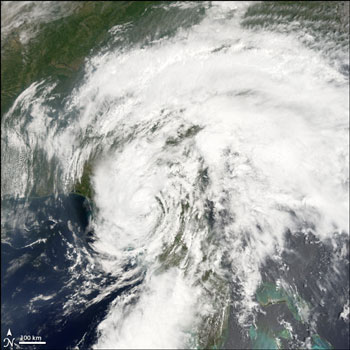 Two new studies point to a strong link between the observed increase in Atlantic hurricane activity and human-induced climate change (the image is tropical storm Alberto on June 13). The basic concept is the same as suggested before: climate change is increasing sea surface temperatures (SSTs) in the tropical Atlantic, and the higher temperatures contribute to more intense and possibly more frequent storms. These new studies drive home the point.
The first study, by hurricane expert Kerry Emanuel and climatologist Michael Mann published in the journal EOS last week, challenges the notion that the upswing in Atlantic hurricane activity is due solely to natural climate cycles. Sea surface temperatures (SSTs) in the north Atlantic tend to oscillate over a 60-80 year period, called the Atlantic Multidecadal Oscillation (AMO), probably due to internal variability in the thermohaline circulation (a part of the ocean “conveyor belt” often mentioned in climate stories and described in An Inconvenient Truth). Scientists often attribute the variability in hurricane activity in the past, especially the increase in recent decades, to this natural cycle. Emanuel and Mann use historical data to show that the increasing trend in Atlantic SSTs is more than an upswing in the AMO, and is likely to be caused by human-induced climate change. They add that it is possible that the emissions of aerosols (NOx, SOx, etc), which lead to regional cooling, may have masked even more warming.
Emanuel originally presented these ideas at the same meeting last fall where a speech by NASA scientist Jim Hansen's drew the ire of government officials [and led to all that news coverage of attempts to quiet government scientists]. During the presentation, Emanuel expressed concern that the line "changes in hurricane activity are due to natural cycles, not global warming" was appearing in every news story about Hurricane Katrina because government scientists were not permitted to say otherwise. The comment drew a round of applause, pretty much unheard of at a scientific meeting.
The second study, by Kevin Trenberth and Dennis Shea at the National Center for Atmospheric Research, estimates the contribution of different factors to the increase in Atlantic SSTs (see the press release). They find that human-induced climate change is responsible for almost half increase in SSTs that fuelled the strong 2005 hurricane season (difference between last fall and the 1901-1970 average). Like the Emanuel and Mann paper, they find the AMO has had less influence on the recent rise in Atlantic SSTs than previously suspected.
Neither of the studies is claiming any particular storm was caused by global warming. Climate science always comes down to probabilities. In the case of hurricanes, warmer waters increase the probability that a tropical depression will grow into a hurricane (simplistic explanation, yes, many other factors like vertical wind shear are obviously important too). You could think of all these climate studies and forecasts like advice from your doctor. For example, say the doctor tells you to quit smoking. The doctor knows that smoking won't absolutely ensure you'll get lung cancer. Even if it did, the doctor couldn't possibly tell you exactly when or where the cancer would form. But the doctor knows the science, knows the statistics, and concludes smoking will dramatically worsens your odds.
Wednesday, June 21, 2006
Climate of fear
The BBC News 4 show Panorama recently had a show called "Bush's climate of fear" that investigated how the US government under the Bush Administration has attempted to squash scientific evidence for climate change. You can watch the entire program online here.
It is worth watching for the good interviews with a number of US government scientists [including a colleague who works on climate and hurricane activity] and the fingernails-on-the-blackboard interview with James Connaughton, Bush's senior advisor on environmental policy.
The show itself appears opinionated, not-so-subtly and not-so-fairly suggesting that the Bush Administration alone is responsible for global warming (the treatment of Texas in particular is unfair). That is, however, another reason to watch. The fact that this program was on the BBC demonstrates just how low the opinion of the Bush Administration's treatment of climate change, and science in general, is in the rest of the world.
Monday, June 19, 2006
Blogging again
 Upon returning from holiday, I planned to write a bit about Kiribati, the Pacific island nation where I've done some field work, and source of the word "maribo". It turns out, the forgotten country has actually been in the news.
You may have come across headlines about an international vote on commercial whaling (here's a whale photo I shot years ago while trying to block out the sounds of all the sick people on the boat). At the International Whaling Commission annual meeting this weekend, a narrow majority of 70 member nations led by Japan voted to overturn the 20 year old ban on commerical whaling. That is well short of the two-thirds majority necessary to overturn the ban (which explains the confusing headlines) but represents a big shift from the past.
Under the ban, catching whales is permitted only for some indigenous peoples in the Arctic and for "scientific research". Three countries argure that some whale populations (like the minke) have been recovering defy the ban: Norway, which ignores the ban entirely, and Japan and Iceland, which use the research loophole to continue whaling. Japan is now pushing the questionable argument that whale numbers have recovered so much that commerical whaling is necessary to maintain fish stocks.
Here's where Kiribati comes in. It is one of a few Pacific island nations, also including Tuvalu and the Solomon Islands, to join the IWC in recent years and support Japan's effort to end the ban. People are suspicious the votes of these poor nations are being "bought".
One of the things a visitor to the western Pacific island nations, like Kiribati, will notice is the many Japanese and Taiwanese funded development projects. Kiribati covers a huge swath of the Pacific and lots of prime fishing grounds; it is also a very poor country, per capita GDP of around $700/person. Many have been suspicious that a bit of financial assistance can go a long way to securing fishing rights. Why Taiwan? Take a look at the list of countries that recognize Taiwan as an independent nation. It is as bizarre as the coalition of the willing.
Under the IWC, each member nation gets one vote, regardless of size of the country or number of inhabitants. So if you are Japan, the sparsely populated island countries like Kiribati and Tuvalu seem like ideal places to search for a vote, no?
Tetabo Nakara, the Kiribati Fisheries Minister and a pretty nice guy, denies the accusation that his country's vote was bought. Sure, no one really believes there was a straight-up bribe. But it is very likely that and other nations like Tuvalu and the Solomons were swayed by trust in Japan, derived in large part from the financial aid, and the Japanese argument that the ban on whaling threatens fish stocks.
I'm not a whale ecologist or expert. I can't tell you whether or not there are some legitimate scientific arguments in support of at least limited whaling. I can tell you, though, that this vote does not look so clean.
Saturday, June 10, 2006
Thursday, June 08, 2006
Recycling tips
The incredibly useful article "How to Recycle Practically Anything: Old Myths are Shattering and New Options Come Online" in the May/ June issue of E! The Environment Magazine begins like this:
Don't throw away those exercise videos and ubiquitous AOL CDs. Jim Williams wants you to mail old videotapes and CDs to him, so that more than 40 disabled staffers at his ACT Recycling in Columbia, Missouri can recycle them. And, oh, don't toss out those used Fed-Ex envelopes or broken smoke detectors; their manufacturers take them back for recycling.
Read the article online. Afterwards, I bet you'll decide to tack a copy to the fridge.
Friday, June 02, 2006
The meaning of consensus
Scientists often talk of there being a "consensus" on global warming. Al Gore addresses this issue directly in An Inconvenient Truth by citing a 2004 study on the extent of agreement among scientists.
The study by Naomi Oreskes, published in Science, examined all the peer-reviewed scientific journal articles between 1993 and 2003 in which the abstract contained the phrase "global climate change". The search was conducted using the Web of Science, a popular search engine used by scientists for surveying the popular literature.
Of the 928 papers she found, not one was skeptical of the notion that "most of the observed warming of the last 50 years is likely to have been due to the increase in greenhouse gas concentrations", to quote the IPCC. In other words, every single paper supported the general idea that the emissions of greenhouse gases due to human activity is influencing the climate.
For fun, I did my own search. During that same time period, there were eight peer-reviewed scientific papers supporting "distance healing", that is, having someone else, without your knowledge, pray for your health; one paper with evidence for the existence of “psi”, alternative means of transfering information like telepathy; and another arguing that the "sense of being stated at" is a result of extrasensory perception". A lot of nutty stuff. But not one paper that used the phrase "global climate change" that was sceptical of the evidence for human-induced climate change.
I won't claim that Oreskes' study is perfect. Change the search terms, for example use just "climate change", and you will find a few papers examining previous climate changes in the geological past that may be sceptical about the extent of the human role in today's changing climate. The sceptics are still a very very small minority. The take-home message is, however you cut it, the consensus is overwhelming.
For years now, media coverage has wrongly presented the two "sides" of the debate as equal, thanks in large part to lobbying by special interests like the oil and coal industry and the tendency in popular journalism to devote equal space and time to both sides of an issue. We are just now seeing the mainstream press, like USA Today, accept that there really is an incredibly strong consensus on the issue. So if you ever are irritated that some scientists or environmentalists seem to be trying to sell the science of climate change to the public in an almost political way, try to understand that the experts in this field have only resorted to such tactics because for years they were forced to swim upstream, to see the true state of the scientific agreement misrepresented to the public.
Thursday, June 01, 2006
A real opening day
An Inconvenient Truth opens nationwide today (see my mini-review). A satirical take on the film from the Onion:
Critics Blast Al Gore's Documentary As 'Realistic'
May 31, 2006 NEW YORK— The Al Gore-produced global-warming documentary An Inconvenient Truth is being panned by critics nationwide who claim the 90-plus minute environmental film is "too disturbingly realistic and well-researched to enjoy." "I found it difficult to suspend my disbelief in man-made climate change for the first half-hour—and utterly impossible after that—which makes for a movie-going experience that's far more educational than it is enjoyable," said New York Post film critic Skip Hack. "Gore's film overwhelms viewers with staggering amounts of scientific information until nothing about global warming is left to the imagination, and that's just not good entertainment. Two stars." Some critics have called the film's claims that sea levels could rise 20 feet somewhat sensationalistic, although most agree that this is not enough to save the film from being unwatchably factual.
It is a shame Skip Hack isn't the real NY Post film critic. The Post's actual review is a bizarre attack on Gore and a diatribe about taxes. I don't know what movie the reviewer was watching.
Opening day??
The Atlantic hurricane season "opens" today. It has been promoted in the press like opening day of the baseball season, as if the president is scheduled to throw out the first water bottles to a stadium packed of storm-ravaged residents of Miami.
To mark the occasion, protesters have been gathered outside NOAA Headquarters in DC to demand "NOAA stop covering up the growing scientific link between severe hurricanes and global warming while insisting on real solutions to the problem of global warming". Here's the press release.
I'm as mad as anyone about the US government quieting scientists, especially with reference to news reports last fall that claimed there is no link at all between changes in hurricane intensity and climate change. I also think protests can be effective.
But in the word of my friend Howard Berger, who works in tropical meteorology and forwarded the press release, a little knowledge can be dangerous.
My fear is that this group and many in the press are now being a bit loose with the science and may contribute to some unrealistic expectations.
Let's get one thing straight. There will not be any hurricanes today. There may not be any all month or for two months. This is weather and climate, we can make predictions, but we can’t print out a 162-game schedule for every town and city.
Yes, there is even more science – reported this week in the NY Times, the Toronto Star and other places – linking human-induced warming of sea surface temperatures in the tropical North Atlantic to hurricane development. Most climate models agree that the observed warming in the tropical Atlantic can only be explained if you consider the increase in greenhouse gases in the atmosphere. The new argument is that tropical depressions and storms have, on average, been forming further to the east, such that they are passing over more of the warming ocean water, increasing the likelihood the storm develops into a strong hurricane. The science is still not definitive. And even if it were, it will not tell us exactly what will happen this year, next year or in any particular year.
The tragedy of Katrina and the news of a plausible climate change - hurricane link have thankfully led to more awareness of the destructive power of the tropical storms and hurricanes. They have also led to a ridiculous media feeding frenzy, like we are all watching the NASCAR race just for the crashes, to the point that if there are no destructive hurricanes this year, rather than celebrate the lives not lost and the homes not destroyed, people outside of vulnerable costal regions will be disappointed and maybe even start screaming that global warming is a hoax.
Tuesday, May 30, 2006
One small step
Some news from the other side of the Atlantic. New drivers in the UK will be forced to learn efficient driving - like accelerating and braking slowly - as a part of standard driving education (see this month-old article in The Observer).
It brings to mind the important point not stressed nearly enough by all the organizations promoting hybrid cars: it is not just what you drive, it is how you drive. Before you start laughing - where does some scientist who cycles to work tell me get off telling me how to drive or maintain my car? - here's an example.
Keeping your tires properly inflating, besides being safe and an all-around good idea, will save most folks about one mile per gallon (mpg). U.S. cars drove a total of 2.3 trillion miles in 2001 (latest year with data, from the Energy Information Administration). So if the average fuel efficiency increased from the current 25 mpg to 26 mpg, that would save 3.54 billion gallons of gas.
How much is that? The median estimate from the US Geological Survey of extractable oil in the Alaska National Wildlife Refuge (ANWR) is 7.7 billion barrels (a conservative estimate). It would take about 50 years to extract all that oil. Since there are about 19.6 gallons of gas in a barrel of oil, the ANWR oil equates to just under 3 billion gallons of gas a year.
In other words, Americans checking their cars' tire pressure every few weeks = all the oil in ANWR.
Is this comparison a cheap ploy? Of course. I wouldn't write a PhD dissertation on the subject. Nor would I claim checking your tires, cutting down on the a/c or not slamming on the gas could ensure there's no oil drilling in ANWR. I merely hope to remind everyone that the small actions do matter.
Sunday, May 28, 2006
From Canada.com: "Prime Minister Stephen Harper's government has bowed to international pressure, reluctantly taking a step toward a ''Kyoto 2'' agreement on climate change". It's too early to say exactly what this will mean. At least the obstructionist stance has been dropped for now.
Now the Harper government has to get the policy right within Canada. The proposed Alberta emissions policy reported in Saturday's Globe and Mail -- to reduce greenhouse gas emissions per barrel of oil produced -- is exactly the type of tricky logic I warned about in a column a couple weeks back.
Don't forget to let me know once you've used the carbon calculator (below)!
Saturday, May 27, 2006
If you're stuck in front of the computer this weekend, read Bill McKibben's column in the Washington Post about how to tell whether politicians take climate change seriously. And afterwards, take a few minutes to estimate your personal CO2 emissions (see below).
Thursday, May 25, 2006
An Inconvenient Truth
Last night, I went to see the new Al Gore documentary about climate change [opened in New York at Landmark Sunshine Theatres on E. Houston, between 1st and 2nd – order tickets ahead if you can, it is crowded].
Go see it. And tell others.
As we walked out of the theater, my old flatmate Abby, a social worker in New York, summed it up best: “That was fabulous. I feel so empowered. I want to go do something”.
The film focuses on the presentation about global warming that Al Gore has been giving around the world over the past few years. His beautiful and largely accurate multi-media presentation puts to shame the lousy powerpoint slideshow most of us scientists deliver on the subject. Abby was riveted throughout: “I knew about global warming, but no one had ever explained it so well”.
The film cuts away periodically from the presentation to Gore talking about how the issue became his passion, tracing the story from a college class with the famous scientist Roger Revelle, who first began measuring atmospheric CO2 levels, through attempts to educate other his Washington, the near-death of his son in 1989, the 2000 election and finally to today, where he is trying to increase public understanding, presentation by presentation. Watching the former US vice-president deliver such a literate and passionate explanation of the science will leave you - whether Democrat and Republican, liberal or conservative, American or not - wondering about the direction of, and the competence of, the present administration in Washington. Abby and I had trouble imagining the current president working the slideshow, let alone discussing the science.
Gore stresses that climate change, at heart, is a moral issue. The take-home message is that the future is in our hands, that it is the responsibility of everyone on the planet, especially Americans, to take action to reduce greenhouse gas emissions.
Finally, to be complete, I noticed a few minor mistakes in the science – things like the timing in the temperature reconstruction of the last 1000 years, the exact predictions for melting of glaciers in atop Kiliminjaro, etc. – but they do not detract from the overall presentation. The numbers about global emissions appear wrong because Gore is talking about just carbon emissions, rather than all greenhouse gases. The list of Kyoto signatories is misleading; 180 countries signed Kyoto but that includes all the developing countries that do no have binding emissions targets (not what most people think of when they hear Kyoto). I also thought Gore could offer much more on less carbon-intensive energy technologies, though that is more a point of style than substance.
That all being said, Gore does a terrific job in explaining the basic science, better than most scientists, better than any other documentary I had seen. I'd say scientists could learn more from Gore about how to present climate change to a general audience than he could learn from us about climate science.
Wednesday, May 24, 2006
A number of media outlets have had reported on the draft of the next IPCC (Intergovernmental Panel on Climate Change) assessment report. The report itself will not be officially released until next year. While there may not be any substantial changes in the general results and message between now and then, we should still hold off on reporting anything until the official report is released. It is like reporting the results of a paper that it still undergoing review (for you scientists) or circulating a story or column before it has been vetted by your editor (for you writers) .
And in Canada, the provinces are starting to fight back. Quebec pledged to abide by Kyoto even if the federal government does not (cover on this morning's Globe and Mail). Quebec has always been in a good position to meet Kyoto - because of plentiful opportunities to expand hydropower - so the move is not surpising. It does show that the federal decision to balk on Kyoto is rapidly turning into a real political nightmare for the ruling Conservatives. The Conservatives' best hope for a majority in the next election is to gain more seats in Quebec. Could the provinical decisions influence the federal government to reverse its anti-Kyoto stance? Or might we look back one day and conclude the Kyoto decision was the Conservatives' downfall?
Tuesday, May 23, 2006
Kyoto and how we got here (IV)
Some final thoughts on the state of climate policy in North America (for now).
Is it "impossible" for Canada to meet the Kyoto commitments, as the Conservative Government claims? Not really. It may be expensive but it is far from impossible. The main reason is that the Kyoto Protocol contains a number of flexible mechanisms designed exactly for Canada's predicament (previous post). The other is that the European nations understand Canada's difficult position and may be lenient – but only if Canada makes a genuine effort.
Under Kyoto, there are four means a country can use meet its emissions target:
1. Reduce emissions.
Yes, Canada must reduce the actual GHG emissions by over 30% in only five and a half years. And, yes, accomplishing the 30+% drop through domestic emissions reductions alone is almost impossible (especially with the expansion of drilling in the Alberta tar sands). But that doesn't mean you give up on the effort entirely. There is so much low-hanging fruit here it would be unconscionable to not to at least take a shot. Here are a few pieces of fruit, off the top of my head:
i) federal support for the proposed closure of coal-fired power plants in Ontario (this would pretty much achieve the Kyoto target for Ontario)
ii) similarly, the fed could support more hydro power in Quebec
iii) incentives for consumers buy fuel efficient vehicles and to drive more efficiently
iv) similarly, joining California in a lawsuit against automakers to improve fuel efficiency
v) supporting public transit (possible through the tax break on transit passes, but the program outlined in the budget could operated in a much more efficiently manner)
vi) incentives for energy efficiency in the home (unfortunately, these are being cut!)
vii) program to get businesses to shut lights at night (you laugh, but this would be a significant dent in the country's energy bill)
If you look at the province-by-province emission breakdown, what becomes clear is that had the development in the tar sands not taken off in the past decade, the Kyoto target would not seem so unattainable.
2. Purchase emissions credits
This is what the PM Harper means by "buying hot air" from overseas. Under Kyoto, emissions credits will be available from Eastern Europe. The collapse of the Soviet Union resulted in a shutdown of many industrial activities and drop in GHG emissions since 1990. As a result, Russia and maybe other nations will have reduced emissions beyond their Kyoto targets, and can sell "credits" to the slackers like Canada.
3. The Clean Development Mechanism (CDM)
Under Kyoto, "Annex 1" countries, which are the developed countries like Canada and the European nations that agreed to an emission reduction target, can fund projects in developing ("non-Annex 1") countries, and claim the emissions credits. In other words, Canada can build a solar farm in Ghana and get credit for emissions savings. The effort to meet Kyoto should be (or have been) coupled with funding for projects through CIDA. Why more people were not talking about this, given all the screaming about increasing international aid, is a mystery to me.
4. Joint implementation (JI)
Under Kyoto, Annex 1 countries can also invest in emissions reducing projects in other developed or Annex 1 countries, and get credit for the emissions reductions. This is the least likely of the flexible mechanisms to be exploited.
So, impossible? No. Prohibitively expensive? Possibly. But if Canada puts a serious plan to get just part of the way on the table, the other Kyoto participants may be willing to renegotiate the target, perhaps to the 0-3% below 1990 levels Canada initally intended (PM Chretien lowered it to 6% at the last minute, upon word the Americans were going to aim for 5%. Ah, politics). It is in the other participants' interest to keep Canada a part of the international process. But the Canada - the government and the people - must do its part.
Monday, May 22, 2006
The pressure on the Canadian government to take climate change and Kyoto seriously continues to mount. This from Al Gore, quoted in this morning's Globe and Mail:
"What Canada does matters, and I know enough about Canada to know the Canadian people take their obligations as citizens of the world perhaps more seriously than the people of any other nation on the face of this Earth. . . That is why nations around the world look up to Canada as a source of moral leadership, and if the Harper government -- which is, after all, in thrall to the tar-sands interests and other polluting interests -- tries to take the Canadian people for granted, personally, it's not for me as a non-Canadian to say, but I do not for one minute believe that the people of Canada would ever turn their backs on that noble political tradition."
It may not be fair to claim the Harper government is any more influenced by the tar sands interests than the previous government. It is fair to say that the extremely energy-intensive development in the tar sands - driven by high oil prices (if oil was $30 a barrel, drilling in the tar sands would not be economical) - is the prime cause for the sharp rise in Canada's GHG emissions in the past few years. It is also the cause of Canada's strong economic performance. That is what makes reducing emissions a challenge: Canada chose to couple its future economic growth not just to fossil fuels, but to a very emissions-intensive source of oil.
Sunday, May 21, 2006
The mess continues
According to the Canadian Press, a leaked document shows that Canadian negotiators at the climate talks in Bonn were instructed to avoid deeper emissions cuts for Canada and "block other countries from taking on more stringent commitments". People are calling for the Environment Minister, Rona Ambrose, to resign.
There is a lot of blustering from all sides here. I'd say the take-home message is the Canadian government has officially joined its neighbour to the south as an obstacle to international climate policy.
Word is that Canada will join the Asia-Pacific Partnership on Clean Development and Climate. The APP is a loose agreement between Australia, China, the United States, South Korea and Japan to work on the development and deployment of clean(er) energy technologies.
The APP should not be confused, however, with an international climate policy like the Kyoto Protocol or [Kyoto's origin] the UN Framework Convention on Climate Change (UNFCCC). The APP does not and will not contain any emissions targets, binding or voluntary. It is essentially a agreement to make a trade agreement about some lower emissions energy technologies.
Deals like the APP are not necessarily a bad idea. We all support the proliferation of lower emitting energy technology that could combat air pollution and climate change. Right now, the plan has no specifics and almost no money, so expectations are low. And the real fear is that by involving the major emitting countries, the APP may take away from Kyoto and the development of future "post-Kyoto" international policy under the UNFCCC specifically directed to reduce greenhouse gas emissions and stabilize the level of greenhouse gases in the atmosphere at an acceptable level.
Friday, May 19, 2006
Climate change politics
I've spent the past two days at a meeting on "Climate Change Politics in North America" at the Woodrow Wilson Center in Washington, DC. If you're interested in the state and future of climate policy in the U.S. and Canada, I suggest taking a look at some of the papers from the meeting, available online.
The Trenton Times had a story about the climate change event held in Princeton earlier this week sponsored by NJ Community Water Watch. The event was part of the indie band Guster's "Campus Consciousness Tour". I nearly did a spit-take when the band's leader referred me as 'the good doctor'.


