One of the most difficult hurdles in reducing greenhouse gas emissions is air travel. Unlike with the automobiles, there are currently no clear alternative fuels or propulsion systems for airplanes. And air passenger miles are expected to double in a decade or two.
So it is not surprising to see environmental groups in countries committed to cutting GHG emissions start doing the math on their government's air travel habit (from the Independent):
The inevitable head-on collision between Britain's climate change and aviation policies moves a step closer today with figures showing the total distance flown by the Government's own ministers and senior officials last year alone is equivalent to 14 return trips to the Moon.
Tony Blair, his cabinet colleagues and their officials clocked up 6.5 million air miles, according to the Cabinet Office's list of flights during the 2005-2006 financial year - and in doing so pumped almost 1,000 tonnes of carbon dioxide into the atmosphere, analysis shows.
I'd be curious to see this result for a US election campaign, in which the candidates, especially the presidential candidates, seem to crisscross the country almost daily (are travel logs or schedules readily available?). New York-San Francisco is about ten times the distance of London - Brussels.
At least now some fuel is being saved by cutting out all that evil shampoo and toothpaste that was being carelessly toted onboard.
Tuesday, October 17, 2006
Fly me to the moon


Thursday, October 12, 2006
Support for a hike in gasoline taxes
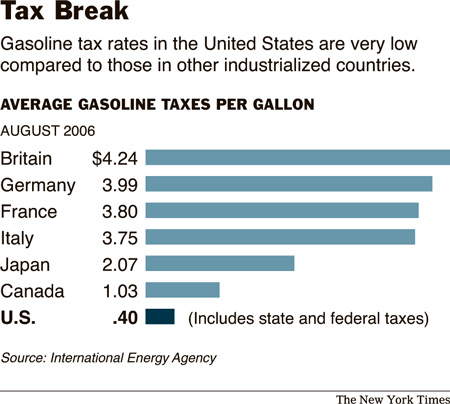 Raising the gas tax or, quelle horreur, introducing a carbon tax has in the past been dismissed as a radical idea from anti-capitalist forces on the political left.
Nothing could be further from the truth. As a recent NY Times story states, economists from all over the political spectrum are now touting the benefits of a gasoline tax. The list includes Alan Greenspan, former chairman of the Federal Reserve (doesn't "the Fed" sound like it is coming soon to a theatre near you, a maverick economist metes out his own form of justice, no, no, not another point in the prime rate).
Harvard economist Greg Mankiw has created a virtual "Pigou Club", named after the economist who first proposed using taxes to correct imperfections in the market, for economists and the like who support increasing gasoline taxes. Check out the diverse list of members.
Wednesday, October 11, 2006
Cleaner diesel fuel on the way
Leaving the Canadian news aside... the NY Times reported today about the development of a low-sulfur diesel fuel. This new fuel could represent a major advance in reducing smog-forming vehicle emissions and , indirectly, fuel efficiency.
Diesel is a generally a more efficient fuel. Small diesel cars can get over 40 miles per gallon, a level otherwise only achieved by hybrid gasoline-powered cars. The problem is that conventional diesel emits much more smog-forming and pollutants, like sulfur, and particulates. As the article reports, diesel vehicles, despite being vastly outnumbered in the US, produce 43% of the nitrogen oxides and more than two-thirds of the soot from American vehicles. If a cleaner-burning diesel becomes available, not only could it improve air quality, it could lead to development fuel efficient diesel and hybrid-diesel cars.
PM plans 'intensity' alternative to Kyoto
I honestly hoped I would be wrong about the "Made-in-Canada' climate policy. The above headline in the Globe and Mail says it all. Again, I suggest reading my op-ed from earlier this year.
Monday, October 09, 2006
Should Australia be worried about climate refugees?
A new study sponsored by a group of NGOs in collaboration with CSIRO - the Australian science agency - states that Australia should prepare for the regional economic and national security fallout from climate change. A primary concern is providing refuge the possibility of hundreds of thousands or millions of "environmental refugees" from low-lying countries in south Asia and the Pacific. Unlike Australia, New Zealand has already reached agreement with Kiribati, Tuvalu and other Pacific nations to accept people displaced by environmental degradation or climate change. Here's the transcript of a short ABC (the other ABC) interview with one of the study authors.
I've not been able to locate a copy of the study (Australia Responds: Helping Our Neighbours Fight Climate Change) itself - if you find one, let me know.
Australia joined the US as a pariah in the eyes of advocates for international action on climate change when, under PM John Howard, it chose not to sign the Kyoto Protocol. The irony is that Australia had negotiated the right to increase GHG emissions by 8% over 1990 levels (by 2008-2012) under the Kyoto Protocol, and may actually be on pace to meet that commitment despite not signing the agreement.
Friday, October 06, 2006
Going on an energy diet
The House and Home section of yesterday's NY Times had a terrific, hilarious "lazy man's guide to belt-tightening at home". It includes a number of useful suggestions for reducing energy use as home.
Though I did take offense, as a Canadian, to this one passage:
"And I recently bought a flat-screen high-def 37-inch TV, an energy-Hoover you’ll have to pry from my cold, dead hands; if you haven’t seen an N.F.L. game on something like that, my friend, you might as well watch curling."
Let me tell you, as I'm old enough now to admit the truth, curling really does make for riveting television.
Thursday, October 05, 2006
Blustering about climate policy in Canada
The Canadian Environment Minister Rona Amborse was 'grilled' yesterday during Question Period about the new climate and air quality policy, according to the CBC. Ambrose failed again to give any specific about the new policy other than "It’s time for a brand-new approach to the environment. This new approach is going to address the real priorities of Canadians in a tangible and accountable way."
The quote and the constant complaints about the former Liberal government's failure to implement an effective Kyoto implementation plan suggests the new policy will have little to do with climate change and international emissions targets, and more to do with what one might call the modus operandi of the current Canadian government: set very achievable goals, and then boast that promises are being met. Maybe that is good politics. It is not good for the climate.
That's why I continue to say watch out for an exotic-sounding but empty "intensity"-based target.
For a foreign take on this issue, try the Washington Post. As the article points out, the new policy may still prove politically divisive, especially if it focuses on emissions from the Ontario-based auto sector and not the Alberta-based oil sector. If so, the Conservative government would fall into similar trap as the Liberals' Kyoto policy, which they gave the auto sector and some industries a pass on emissions reduction. A sensible emissions policy is one that targets industries equally, like the new California policy.
International climate change talks in Mexico
At a gathering in Mexico, representatives of the G20, that is representatives of the self-appointed 'G8' nations and 12 others countries we were deemed worthy of inviting to the party(oh, diplomacy), are chatting about climate change and energy.
According to the BBC, the results are mixed. The countries agree serious action is needed. Rick Samans, head of the World Economic Forum said politicians need to act fast because "We are behind the curve, there is no doubt that we should have acted 10 or 15 years ago" (i think i just pulled a muscle in my rib cage trying to withhold a sarcastic 'oh really?' comment). On the other hand, no promises are being made, and the US, India and Russia appear to be putting little into the conversation.
Tuesday, October 03, 2006
Warming vs. heating
In his recent book "The Revenge of Gaia", the scientist James Lovelock of Gaia hypothesis fame uses the term global heating rather than the more common global warming. In an interview with the NY Times, Lovelock argued:
"Warming is something that’s kind of cozy and comfortable. You think of a nice duvet on a cold winter’s day. Heating is something you want to get away from."
The use of the word heating has caused debate among the sort of people who like to debate these things. Here are a few thoughts on the issue.
Is heating a more ominous word? I suppose it sounds more severe, more like something that you actively force, or is imposed upon you, than warming. Linguists can argue over that. Either way, Lovelock is advocating the use of the word because of the values he believes it communicates, namely that global warming / global heating / climate change is scary and dangerous. That may very well be true. But should such a conclusion be enshrined in the language used by scientists?
Yes, scientists are lousy marketers. You don't need to remind me of that. I work in a field called biogeochemistry. The only people that would voluntarily assume such a horrific label are scientists. Oh, scientifically, it makes senses. Geochemistry is the chemistry of the earth, so biogeochemistry is simply saying if you want to understand the chemistry of the earth, you have to take the "bio" - life - into account. But it sure ain't pretty.
The thing is, maybe we should be lousy marketers. Our objective is not supposed to be selling our results. Thanks to press releases, news articles, blogs and the like, the marketing of your science is often exactly what happens. It is with exactly that trend in mind that we need to be sensitive about using value-less terms to label our disciplines and our results.
I don't know whether people will respond differently to global heating or global warming or climate change. But I know we should not choose the language based on how people will respond, but which is most accurate (within reason, otherwise scientists will drone on for hours with caveats and confidence intervals).
If the media or activists want to take what by all rights should be called global climate change and call it global warming or heating, they can do so. Scientists? We should stick with the dull explanatory labels, whether it is climate change, or biogeochemistry.
Saturday, September 30, 2006
Emissions (or energy) intensity
A snippet of the upcoming Canadian GHG and smog-forming emissions plans (Globe and Mail):
In a separate interview with CTV Newsnet, Ms. Ambrose said the plan would include financial penalties.
Oil industry sources said yesterday the Tories intend to set standards to reduce "energy intensity" in the sector, an approach that would reduce emissions for every barrel produced. That approach, which is favoured by the Alberta government and the industry, would see emissions continue to rise as oil-sands development booms, but would slow the pace of the growth.
Any regulation is better than the current situation. But the intensity trick is what I've been warning about for months (Toronto Star):
Since the days of the Canadian Alliance, Harper and colleagues have opposed the Kyoto limits on greenhouse gas emissions. They preferred the approach of the United States, which refused to sign any international climate agreement under the pretence that it could hurt the economy. The new "Made in Canada" plan is expected to be based upon the current U.S. government policy that the Bush administration adopted in 2002 after rejecting Kyoto... It is worth examining the problem with a U.S.-style policy...
The economy, expressed as GDP, grows at roughly 3 per cent a year. The compound interest function on your calculator will show that this average annual growth rate works out to 34 per cent growth over a 10-year period. The stated target is to have the GHG intensity — the emissions divided by the GDP — be 18 per cent lower in about 10 years. Since the GDP will have increased by 34 per cent, the greenhouse gas emissions can actually increase by 10 per cent over those 10 years. The proposed reduction in intensity is actually an increase in total emissions.
Proponents will argue that this is still an improvement over business-as-usual. If the greenhouse gas intensity remains constant over the 10 years, the total emissions would increase by 34 per cent. In that sense, the reduction in intensity could represent some progress. It would not save the planet from the disastrous implications of climate change but it would be better than nothing.
Actually, no. The catch is that the greenhouse gas intensity of the U.S., of Canada, and of virtually every industrialized country has been decreasing for years as our economies become more productive and our technology improves. How much? Here's the funny coincidence. In the U.S., the greenhouse gas intensity decreased by about 18 per cent between 1990 and 2000.
In other words, the Bush administration climate policy is just a statement about staying the course. It does absolutely nothing to address climate change. Canadians should be wary of any similar Conservative policy that uses words like greenhouse gas intensity and claims to address both the economy and the climate. When the announcement is made, have a calculator handy.
Friday, September 29, 2006
Fallout from the auditor general's climate change report
After reading the news this morning, I looked at my old Globe op-ed on climate change policy, published before the 2004 election (the Martin minority). With the Liberals and Conservatives in mind, I wrote that try as you might to ignore it, climate change is one issue that will not go away, so you'd better come up with a plan.
Well, here we are. Still bickering after all these years.
The Conservative government is keeping quiet on whether any of the recommendations in the Auditor General's report are addressed in the greenhouse gas component of the new Made-in-Canada plan (to be released next week). Most likely, the answer is no. Instead, their focus has been on the auditor general report's well-founded criticism of the previous Liberal government's plan and on Stephane Dion, the former environment minister and now Liberal leadership candidate. Dion's rebuttal has been strong:
CBC:
... called into question Prime Minister Stephen Harper's environmental policies."The prime minister does not believe in the science of climate change," Dion said, describing it as "the worst ecological threat that humanity is facing."
CTV:
.. he said the previous Liberal government proposed a better plan to fight climate change in its last months in power, called "Project Green" -- only to have it axed by the incoming Conservative government. The plan would have cost an estimated $10 billion over eight years, to reduce greenhouse gas emissions by 270 megatonnes between 2008 and 2012.
"It's very important for people to understand (the report) is not about the last plan that we released on April 2005 - the plan that was killed by Mr. Harper," Dion told Mike Duffy Live. "It's about what we have done the years before. And we agree with what she said. It's why Mr. Martin last year brought his ministers together and came up with a much more compelling plan, that would have helped Canada to reach its Kyoto targets on time."
Thursday, September 28, 2006
Canadian Auditor General calls for action on climate change
In the report released this morning, the Auditor General's Office, which is like the principal's office for the Canadian government, called for a "massive scale up of efforts" to fight climate change.
From the Globe and Mail:
Environment Commissioner Johanne Gélinas, who is part of the Auditor General's Office, says Liberal policies — even the most recent 2005 plan introduced by then Environment Minister Stéphane Dion — would not ensure Canada could meet its targets under the international Kyoto agreement.
"Climate change is upon us, and no matter how you look at it, the stakes for Canada are high," Ms. Gélinas said in a statement. "With its resources and powers, the federal government can make a big difference. But our findings show that it has not been up to the task so far."
"There is a foundation to build on, with motivated and talented public servants and good programs that have made some headway in reducing emissions," Ms. Gélinas said in a statement. "What we need now is a commitment to specific actions with time frames for completing them."
Wednesday, September 27, 2006
California passes climate change legislation
The now Hummer-less Governor Arnold Schwarzenegger of California officially signed the ambitious new climate change legislation this afternoon. The law calls for California to reduce its greenhouse gas emissions to 1990 levels by the year 2020, and to 80% below 1990 levels by the year 2050.
Possibly even more significant, Schwarzenegger will probably sign a bill that bars California companies from participating in long-term contracts that involve importing energy from out-of-state sources that do not follow the new greenhouse gas regulations. The bill is aimed at forcing the new coal-burning plants being planned in neighbouring states to adopt carbon capture and storage technology.
Pressure is also building in Canada to impose tougher regulations on the energy industry. The country's Auditor General is about to release a report that criticizes the previous government's Kyoto implementation plan, and calls for the current government to enact more effective legislation aimed at reducing emissions from oil and gas, especially the development in the Alberta tar sands.
Monday, September 25, 2006
From Hummers to Moonbeams
I read with amusement that California Governor Arnold Schwarzenegger has sold his beloved Hummers. All eight. Having signed the most progressive greenhouse gas reduction laws in the US, the Governor decided that owning a fleet of vehicles that get 10 miles per gallon (mpg) was sending the wrong message.
I don't know who bought the cars or what they plan to do with them. But if one's objection to a Hummer is the woeful fuel efficiency, wouldn't the responsible decision be to leave the car in your driveway, rather than sell it, thus ensuring not another drop of fuel enters its 27.5 gallon (104 litre) tank, or its 24 gallon (91 litre) auxiliary tank? Remove the roof and plant some flowers. With eight of them, you could build a botanical garden.
If Gov. Schwarzenegger is in the market for a more efficient vehicle, he could try the 105 mpg Moonbeam, built by Joey Squibb for only $2500 dollars, only half the cost of filling his eight former vehicles with gas (seriously, do the math).
Saturday, September 23, 2006
Water please, hold the bottle
Those of you who know me personally have no doubt heard my rant about the popularity of bottled water in North America. In my opinion, the bottled water industry is based almost entirely on fear mongering about the safety of tap water. Unless you are in a community with no water treatment, drinking bottled water is wasteful, unnecessary, and if anything, more dangerous than drinking tap water. The tap water, unlike the bottled water, is regulated and tested.
The Saturday Globe and Mail has an interesting report about religious groups joining environmental groups in the fight against bottled water. The activists should staple this passage to every bottled water vending machine:
"A one-litre bottle of Dasani brand water, sold at a Toronto supermarket recently for $1.59, retails for about 3,000 times the price of a litre of municipal water from nearby Brampton, where the container was filled. Coca-Cola Bottling Co. filters the municipal water and then adds minerals to improve its taste. Federal product labelling laws do not require bottlers to indicate that their products originally were tap water, but do require companies to say whether it is spring or mineral water."
Friday, September 22, 2006
A change in US climate change policy?
Rumours have been flying for a week or so that the Bush Administration plans to change its tune on climate change, perhaps in January's State of Union address. No one knows for certain whether it will happen at all, or if it does happen, what the change will entail.
The speculation is based entirely on reports from those people that pop up all too often in news reporting today: unnamed sources. Here's the original news story from UK's the Independent, no big fan of the Bush Administration.
17 September 2006 - President Bush is preparing an astonishing U-turn on global warming, senior Washington sources say.
After years of trying to sabotage agreements to tackle climate change he is drawing up plans to control emissions of carbon dioxide and rapidly boost the use of renewable energy sources. Administration insiders privately refer to the planned volte-face as Mr Bush's "Nixon goes to China moment", recalling how the former president amazed the world after years of refusing to deal with its Communist regime. Hardline global warming sceptics, however, are already publicly attacking the plans.
The rethink follows increasing pressure on the White House from Republican governors such as Arnold Schwarzenegger, the mayors of more than 300 cities, business leaders and Congress. Over the past few days rumours swept the capital that the "Toxic Texan" would announce his conversion this week, in an attempt to reduce the impact of a major speech tomorrow by Al Gore on solutions to climate change.
The White House denied the timing, but did not deny that a change of policy was on its way. Sources say that the most likely moment is the President's State of the Union address in January.
Environmentalists expect the measures to fall far short of what is needed, but say this does not matter. "The very fact that Bush would reverse his position will liberate many Republicans to vote for meaningful pollution cuts," says Phil Clapp, president of the National Environmental Trust.
But Iain Murray, a senior fellow at the Competitive Enterprise Institute, Mr Bush's chief climate change cheerleader, is deeply alarmed: "We are left with the unpleasant conclusion that the only motivation is political."
Details of new Canadian emissions policy starting to emerge
Today's Globe and Mail reports that the Conservative government in Canada is preparing to release the long-waited new "emissions policy" that will include tougher rules for automobiles, based on California's "stringent" standards.
The Canadian government has been very careful in the use the generic word emissions in public statements this year Greenhouse gas emissions? Or smog-forming emissions? Or both? We are finally starting to get some clarity with this latest leak. Some.
It appears that the new policy will adopt something along the lines of the tough regulations on smog-forming emissions - NOx, VOCs, etc. - enforced by California's Air Resources Board for several years. If so, this is a sensible decision. Whatever you think of air quality concerns, having tougher standards in different states or provinces is ridiculous. Right now, automakers are actually constructing different versions of the same car. The Honda Accord you buy in California (or New York) will have lower smog-forming emissions than one bought in other states or Canada. So the technology exists.
On greenhouse gases, though, the sources quoted in the article are more vague. The Environment Minister has suggested the new policy are looking at a California plan to reduce CO2 emissions from automobiles (ie. via increase fuel efficiency). No details are given.
The California plan called for a 30% reduction, originally by 2016. A collection of eight northeastern states have suggested they may also adopt the rule, although nothing is definite. For a couple years, there have been calls from people on both sides of the border for Canada, the Kyoto signatory, to also join the initiative. The previous government was reluctant to put pressure on the automotive industry and instead adopted a toothless voluntary plan.
Tuesday, September 19, 2006
Darfur and resilience to climate shocks
Rallies were held around the world on Sunday to demand UN intervention in the Darfur region of Sudan. I had expected to see a large turnout at the New York rally. It was heartening to see that young people made up the majority of the 20,000 that gathered in Central Park. A number of the speakers mentioned that the fraction of young faces in the audience countered the notion that the younger generation doesn't pay attention to what is happening around the world.
As I mentioned in the last post, the ongoing drought in central Africa may have helped fuel the tensions that led to the current crisis in Darfur. The same argument has been made for other conflicts. The logic is that people in places like southern or western Sudan, where there is limited infrastructure (or grain reserves), the people there are less resilient, to use the popular term in ecology, to drought than, say, North Americans.
The comparison is not wrong, just simplistic. First, in reality, there is a distribution of resilience in each region, country or society, regardless of development status (take a look at New Orleans). Climate 'shocks' like floods or droughts tend to hurt the worst off in each place. Second, with the global exchange of people, goods and resources, the resilience of one region influences that of another. North America may be immune from the direct impact of a drought in a place like Afghanistan, Ethiopia, or Darfur, or a major wheat-growing region like Russia or India. However that same drought could inspire military intervention, a shift in crop prices or demand, or a rise in oil prices that will affect North America. That’s why it is important not to treat the various impacts of climate variability and climate change as separate boxes - a drought here, a flood there. More attention needs to be paid to the potential cascading effects of that drought, that flood.
Saturday, September 16, 2006
Global Day for Darfur
I'm veering a bit off of the subject of climate here... As you've probably heard, the Sudanese government has placed a deadline of September 30th for the withdrawl of the African Union peacekeepers from the Darfur region. This Sunday, rallies are being held in cities around the world to call for UN intervention. People attending the rallies are being asked to wear a blue hat to symbolize the need for UN peacekeepers in Darfur.
I’ll be going to the rally in New York (from 2-5 pm, in the East Meadow of Central Park). For information about the plans in your area, check the Global Day for Darfur site. Retired Canadian General Romeo Dallaire, head of the UN mission in Rwanda, will be keynote speaker at the Toronto rally.
Not that the climate has been irrelevant here. Many experts feel the ongoing drought in central Africa may have played a role in the Darfur crisis, just as the 1990s drought in Afghanistan may have played a role in the rise of the Taliban. In the case of the Sudan, changes in rainfall brought the nomadic peoples into conflict with settled pastoralists. If you are interested in the subject, I recommend this article in the magazine Seed.
Thursday, September 14, 2006
El Nino on the way
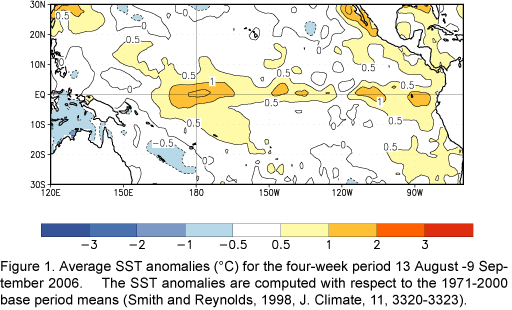 There's a mild El Nino event brewing in the Pacific. The forecasters have suspected as much for the past couple months. The latest data (right) showing abnormally warm water in the central and eastern Equatorial Pacific led to the El Nino forecast by NOAA.
This is not expected to be anything like the strong 1998 El Nino event. But we will probably see some of the climate effects of El Nino, including dry weather in Australia and the western Pacific, a milder winter and spring in central North America and wet weather in Florida and the Gulf Coast.
The warming in the central Pacific could impact the reefs there. The coral bleaching event I surveyed in western Kiribati (intersection of the equator and the dateline, right under the orange spot in above map) in 2004 occurred after a very similar build-up of ocean temperatures from July-December. Bleaching is a paling caused by a breakdown of the symbiosis between the coral, the reef-building animal, and the colourful algae that lives in the coral's tissue. If the conditions that cause bleaching persist, like abnormally ocean waters, the corals can die. That's not the end of the story, though. The reefs can recover - the evidence from my colleagues suggests the corals have been returning after the high mortality we measured. The ecological questions are more how the community changes due to a bleaching event, and what happens if the disturbances (ie. the warm water) occur more frequently than in the past.
A couple weeks ago, NOAA Coral Reef Watch put out a bleaching warning for western Kiribati and the U.S. islands in the area (thanks in small part to my ranting). It will be interested to see, if the temperature stress continues to build, how the coral community responds. There is evidence that some corals can acclimate or adapt to warming ocean temperatures, by shifting the symbiosis to more temperature-tolerant algae. This may be an interesting test. Now if only someone wants to fund my research proposal...


