Last Thursday I gave a talk at the annual American Association of Geographers meeting in Seattle. The AAG attracts throngs and throngs of academic geographers from around the world. Frankly, the meeting is so big you need to be a geographer to navigate your way to a chosen talk, the subject of which may very well be a Marxist analysis of neoliberal influence on the map of the conference centre (“the orientation places the economic geography presentation rooms at the top”).
Seattle is just close enough to Vancouver that someone who is busy, or who possesses an unrealistic and slightly delusional sense of what is possible in a fixed amount of time, or, in my case, both, could convince himself to go there and back in a day. I chose to take the bus, rather than drive, because doing so is more energy efficient and would give me the chance to do some work.
The return bus fare was $48 (that’s Canadian $ for those of you scoring at home). It was, I later discovered, a bit of a deal – return fares can run up to $72 or so. That morning, the price of gas at the station near our house was $1.33 per litre (L). At that price, in order for a single-occupant vehicle trip to be cheaper than the bus fare, the car would need to average less than 7.88 L per 100 km (or 30 mpg) on the 458 km return trip from our house to the conference centre*.
You are unlikely to get that fuel efficiency with anything other than a small vehicle or hybrid car, especially given the traffic you can expect to encounter. And that’s not including the cost of parking. If you add in $20 for parking, the car would have needed to average 4.6 km/100 L, or 51 mpg, which is probably only possible, if at all, with a carefully-driven Toyota Prius, a Chevy Volt, one of the older two-door Honda Insights, or maybe Nissan Leaf if you asked the polar bear in the backseat to hold a bunch of extra batteries on his or her lap. Even at the premium, book-at-the-last-minute bus fare of $72, a car would still need to average at least 11.8 L/100 km (~20 mpg) excluding parking costs, or 8.5 L/100 km (27 mpg) including parking costs, in order to best the bus costs. In other words, at today’s price, there is a clear and immediate financial benefit to leaving the car in the driveway and taking the bus**.
At low prices, gasoline is inelastic. The price won’t significantly influence our behaviour. But as prices move well upwards of $1 per L (towards $4 per gallon), the story may change. The last time gas prices reached beyond today’s level there was an increased demand for high-efficiency vehicles and public transit.
The problem, to remove my scientist hat and channel Thomas Friedman, is that the price signal is coming from the wrong place. Right now, gas is expensive because of the price of oil. The proceeds are going to the oil industry – some of that money stays here in Canada, but much of it goes overseas – and inspiring more exploration, which could conceivably lower prices, or maybe to things like CEO bonuses. If the price of gas were high because of a tax, especially one for which the revenue was invested in things like transit, improved automotive fuel efficiency, battery technology and charging stations, wouldn’t we all be better off? I’d guess that the only thing people hate more than paying a premium at the pump is paying that premium to oil companies.
*L per 100 km? What foreign tongue is this you ask? Canada and the metric world measures fuel efficiency as the gasoline required to go a distance, whereas the US and some other nations use the distance you can cover on some fixed quantity of gas. That difference is in itself rather fascinating, and probably the subject of someone’s cultural geography thesis.
** A full accounting would include the wear and tear on your car – with that, the bus wins hands down over any car on the market. I’ve ignored that here because I’m interested in what will most likely factor into the choice of bus vs. car. My sense is that people don’t consider the daily dribbling costs of wear and tear when making decisions. We moan when the mechanic says you need a new fan belt, but don’t think about the prorated cost when going on a subsequent trip. So we’re unlikely to make a decision based on the per km wear and tear. This is just a hunch; I could be wrong.
Monday, April 18, 2011
An argument for a gas tax


Tuesday, March 10, 2009
By boat, by train, by plane, by bike
 Good Magazine published this fun comparison of fuel per passenger required to travel 560 km (350 mi) by various modes of transportation, including the fuel used to create the food that fuels the walker and the cyclist.
The winner? The cyclist at 912 miles per gallon, or 0.26 L/100 km.
The cruise ship at the top of the chart gets a rather sad 0.009 mpg. So if cram more than 101,133 passengers on the ship and don't feed any of them, you may be able to can match the efficiency of a bicycle (ignoring how the mass of all those people would reduce the fuel efficiency of the ship).
Friday, January 18, 2008
Funding and new transit announcements
Earlier this week, British Columbia announced a massive new public transit plan including over $10 billion for rapid transit lines in my new home of Vancouver. It has raised much excitement but also many questions about who will be paying for it all.
A couple days later, the Globe and Mail reported that Canada will copy the new and relatively meaningless US vehicle mileage standards. Today it rather ignorantly reports the move will increase automobile prices by thousands of dollars (even if it were true that costs have to go up to meet the standards, it would happen regardless of the Canadian decision because prices are driven by the US market).
You get the feeling that Canadians are concerned only about cost of transportation, not the efficiency. For the foreign readers of Maribo, it is important to understand that thanks to Canada's unique federalist system, 95% of the political life in Canada is spent arguing over which level of government should be paying for things. We tend to roll out massive public spending programs or new federal regulations without having secured any of the funding. With programs like the BC transit plan, the hope is that by generating excitement, the level of government announcing the program can guilt the other levels into coughing up some money.
Most of the time, guilting the province or the feds fails. So Canadians are quite skeptical of grand proposals for things like expanding public transit, building new inter-city train lines, etc. If you want to raise the ire a Torontonian, just ask about the waterfront redevelopment plan (the response will begin with "which one?").
On the odd occasion, the guilt approach actually works. We Canucks are, after all, generally apologetic people who hate to disappoint others.
Is this one of those odd occasions? Perhaps we've reaching this nexus of voter concern about climate change, oil prices, urban air pollution and traffic congestion that the every level of government will find a way to contribute at least a decent proportion of the requested funds for the BC transit plan, for Toronto's light rail plan, etc. Don't expect the SkyTrain all the way down Broadway to UBC to appear anytime during, say, the current millennium. And don't expect the auto manufacturers in Ontario to suddenly embrace new fuel efficiency standards. But I can guarantee you no one, at any level of government anywhere in the country, wants to look like Alberta Premier Ed Stelmach, who toured Washington this week trying to deny the environmental impact of oil sands operations*.
* The argument: large facilities are required to "reduce the intensity by 12 per cent." This while they plan to triple production. So if intensity is the emissions per unit of production, that means the emissions would multiple by 2.64. Canadians do understand fractions.
Friday, January 11, 2008
Cheaps cars for everyone?
While I appreciate it is ridiculous for anyone in North America, where the myth of the open road originated and where the average car current gets worse mileage than a 1976 Datsun, to complain about automotive developments in other parts of the world, it is hard not to wonder whether the release of $2500 Nano will be a disaster for the planet, not to mention India's already crowded roads and hospitals, destroying whatever naive hope that the developing world can leapfrog past our car-based culture to an efficient, modern transportation system.
At least the Nano gets 47 mpg (and isn't made out of clay).
Friday, August 03, 2007
US Congress to debate Energy Bill
The US Congress is debating an Energy Bill today (HR 3221 – read it here). It is different from the recently passed Senate Energy Bill in a number of ways.
Otherwise, the bill is a grab-bag of different projects, many good (testing photovoltaic roofs), many oddly specific (no incandescent lights on coast guard vessels), many that will be labeled pork barrel (money for some rather specific biofuel programs) and many that will cause a double-take (a line item study on ice sheets!).
And then there is this:
Sec. 6102. MANAGEMENT OF FEDERAL GOVERNMENT GREENHOUSE GAS EMISSIONS… so as to achieve zero net annual greenhouse gas emissions from the agencies by fiscal year 2050.”
Yep, the bills says all US government operations are to be carbon neutral by 2050. As the NY Times reports, that would include the Pentagon. Let’s just hope this isn’t used as an argument to shift to nuclear, rather than conventional, warfare.
That is one area where Iraq is leading the US; as Eli points out, if the present trend continues, electricity generation in Baghdad will become carbon neutral by the end of 2008.
UPDATE: President Bush has threatened to veto the bill.
Wednesday, December 20, 2006
Reducing emissions at an airport near you
There was a full page ad in Monday's NY Times for the new Boeing 747-8 praising the aircraft's fuel efficient engines, and Lufthansa for buying a few.
The ad, if not the plane, seemed to represent a major shift. Not long ago, airlines and aircraft builders would highlight the only the comfort, the leg room, of new planes. Now it is all about marketing energy efficiency and re-branding (oh, I loathe that term, why not just call the public cattle?) your company as clean and green.
For the airlines, though, it will need to be about more than marketing. The Associated Press reports that airlines flying in Europe will be specifically included in a greenhouse gas emissions trading program. The European airlines have come out in favour of the decision, because it easier on them than the alternative, higher airline taxes. The program will apply to all internal flights beginning in 2011, and all flights in and out of Europe by 2012, thus influencing U.S. and other foreign carriers as well.
Tuesday, October 24, 2006
The most fuel efficient cars
I've been too busy lately to keep up the regular posts. I did, however, come across this earlier today.
According to the US EPA, here are the cars with the highest fuel economy for the 2007 model year:
1. Toyota Prius (hybrid-electric)
2. Honda Civic Hybrid
3. Toyota Camry Hybrid
4. Ford Escape Hybrid FWD
5. Toyota Yaris (manual)
6. Toyota Yaris (automatic)
7. Honda Fit (manual)
8. Toyota Corolla (manual)
9. Hyundai Accent (manual) , Kia Rio (manual)
10. Ford Escape Hybrid 4WD , Mercury Mariner Hybrid 4WD
The list from Natural Resources Canada includes Honda Insight hybrid (I don't know why this didn't top the US list, perhaps it is no longer available here?) and the Mercedes Benz Smart Car (not found in the US).
Notice a trend? Only one of the top ten, the Ford Escape hybrid, is American, and not only does it rely on technology purchased from Toyota, it probably would not be ranked so high if the EPA tests simulated the way people actually drive (ie. faster, more erratically and with the a/c cranked). You can't help but wonder if the main reason the American car companies are struggling is that they are building the wrong cars.
Thursday, October 12, 2006
Support for a hike in gasoline taxes
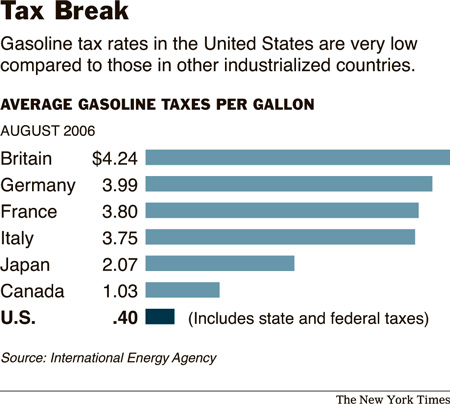 Raising the gas tax or, quelle horreur, introducing a carbon tax has in the past been dismissed as a radical idea from anti-capitalist forces on the political left.
Nothing could be further from the truth. As a recent NY Times story states, economists from all over the political spectrum are now touting the benefits of a gasoline tax. The list includes Alan Greenspan, former chairman of the Federal Reserve (doesn't "the Fed" sound like it is coming soon to a theatre near you, a maverick economist metes out his own form of justice, no, no, not another point in the prime rate).
Harvard economist Greg Mankiw has created a virtual "Pigou Club", named after the economist who first proposed using taxes to correct imperfections in the market, for economists and the like who support increasing gasoline taxes. Check out the diverse list of members.
Wednesday, October 11, 2006
Cleaner diesel fuel on the way
Leaving the Canadian news aside... the NY Times reported today about the development of a low-sulfur diesel fuel. This new fuel could represent a major advance in reducing smog-forming vehicle emissions and , indirectly, fuel efficiency.
Diesel is a generally a more efficient fuel. Small diesel cars can get over 40 miles per gallon, a level otherwise only achieved by hybrid gasoline-powered cars. The problem is that conventional diesel emits much more smog-forming and pollutants, like sulfur, and particulates. As the article reports, diesel vehicles, despite being vastly outnumbered in the US, produce 43% of the nitrogen oxides and more than two-thirds of the soot from American vehicles. If a cleaner-burning diesel becomes available, not only could it improve air quality, it could lead to development fuel efficient diesel and hybrid-diesel cars.


